
Affiliate Disclosure
Cat & Whisker participates in the Amazon Associates Program. We may earn a commission on qualifying purchases — at no extra cost to you. We only recommend products we’d genuinely put in front of our own cats. Read our full disclosure policy.
For multi-cat households, the Litter-Robot 4 is the top all-around pick for capacity and reliability, while the PETKIT PuraMax 2 works well as a compact secondary unit and the ScoopFree Crystal Classic is suitable for guardians who want to avoid clumping litter entirely.
Multi-cat homes need higher waste capacity, faster cleaning cycles, and stronger odor control than single-cat homes. This guide compares the best automatic self-cleaning litter boxes for multiple cats, covering waste drawer capacity, sensor reliability, litter compatibility, and hands-free convenience.
Why automatic self-cleaning litter matters in multi-cat households
Traditional litter trays can become overwhelmed quickly when several cats share one box. According to AAHA/AAFP feline life stage guidelines, the standard rule of thumb is one litter box per cat plus one additional box — or one box per social group plus one extra.
However, when space or budget limits how many trays you can provide, a high-capacity self-cleaning litter box can help bridge the gap.
A quality automatic litter box reduces the need to scoop. It keeps the litter area cleaner and can meaningfully reduce odors by removing waste from the clean litter shortly after each use.
A practical workaround, not a replacement
It’s worth being clear-eyed here: an automatic box is a practical workaround, not a replacement for the n+1 guideline. Going below the recommended number of boxes — even with a self-cleaning unit — may still increase stress or the risk of house-soiling in some cats. Monitor behavior closely if you’re relying on fewer, higher-capacity boxes.
Key features to look for in a multi-cat automatic litter box
Not all self-cleaning models are built for multiple cats. When shopping, prioritize these features:
- Waste drawer capacity for multi-cat use: A larger waste drawer or removable bin means fewer emptying cycles for households with two cats or more.
- Reliable presence sensors and automatic cleaning: Sensitive, well-engineered sensors detect when cats leave and trigger cleaning without startling them. Look for documented anti-pinch and cat-presence detection systems rather than vague “pet-safe” marketing language.
- Litter compatibility: Some smart litter boxes are built around proprietary crystal litter trays, while others — like Litter-Robot and PETKIT models — are designed around standard clumping litter. Check compatibility before committing to a system, since switching litter types later can mean buying a different machine entirely. Most multi-cat-capable units do not require special litter beyond this — Litter-Robot and PETKIT both work with widely available clumping litter, while ScoopFree is the exception that requires its own proprietary crystal trays.
- Odor control: Sealed waste drawers, carbon filters, and designs that separate clean litter from waste all help cut down on odor in multi-cat homes.
- Easy to clean and maintain: Hands-free operation is great, but parts should still be simple to disassemble for periodic deep cleaning.
- Notifications and health tracking: Many current models offer app notifications and per-cat usage tracking. For example, the PETKIT app can flag that one specific cat’s litter box visits have dropped over a few days — a pattern change worth mentioning to your vet before it becomes a bigger issue.
How self-cleaning litter boxes work — and are they worth it
Most automatic litter boxes use one of two mechanisms: a rotating or sifting globe/bin (Litter-Robot, PETKIT) that separates clumps from clean litter after a cat exits, or a rake-based system (ScoopFree) that periodically drags waste into a covered trap. Sensors — typically a mix of weight and optical detection — confirm the cat has left before the cleaning cycle starts.
Safety mechanisms like anti-pinch sensors stop the cycle if anything is detected in the way.
Veterinarians and behaviorists generally don’t object to self-cleaning litter boxes, and many cats adapt to them well. Vets typically frame the decision around hygiene and monitoring rather than necessity: a clean box reduces the chance of cats avoiding litter use (a common trigger for house-soiling and urinary issues), and several models’ usage-tracking features can help owners spot behavior changes worth flagging to a vet. No major veterinary body specifically “recommends” one brand over manual scooping, but consistent cleanliness — however it’s achieved — is the actual veterinary priority.
Are self-cleaning litter boxes worth it?
For multi-cat households specifically, yes, with caveats. The math is straightforward: a household with three or four cats sharing manually-scooped boxes is a daily, sometimes twice-daily, chore — and skipped scooping is one of the most common reasons cats stop using a box. A self-cleaning unit with a large waste drawer turns that into a weekly task. The trade-off is upfront cost (most multi-cat-capable units run $400–$700) and the need to still follow the n+1 box guideline rather than relying on a single high-capacity unit to do the work of several boxes.
Top models for multi-cat households
The Litter-Robot 4 is the strongest all-around choice for most multi-cat homes, the PETKIT PuraMax 2 is the best compact or secondary option, and the ScoopFree Crystal Classic is the right pick if you want to avoid clumping litter entirely. Here’s how each one breaks down.
Litter-Robot 4

- MONITOR + CONTROL VIA APP: Control the smart litter box straight from the Whisker app. Monitor waste and litter levels i…
Whisker’s current lineup includes the Litter-Robot EVO, Litter-Robot 4, Litter-Robot 5, and Litter-Robot 5 Pro. For multi-cat homes, the Litter-Robot 4 and Litter-Robot 5 Pro are the most frequently recommended.
Litter-Robot 4 is built around clumping litter — Whisker’s manual specifies clay-clumping litter and small-particle litter beads/crystals that pass through the screen. It explicitly advises against paper-based, wood-based, or non-clumping litters. The unit uses Whisker’s OmniSense Cat Detection System (a combination of optical and weight sensors) along with a dedicated Anti-Pinch Safety Feature on the waste drawer chute.
A Drawer Full Indicator monitors waste level and alerts you via the Whisker app, which also tracks litter level, usage patterns, and individual cat weight over time. Whisker markets the Litter-Robot 4 for households with up to four cats, with a “large” waste drawer that typically needs emptying about twice a week for two average cats.
For cat parents who want more detailed per-cat insight, the Litter-Robot 5 Pro builds on that same foundation with a notable jump in health tracking.
Litter-Robot 5 and 5 Pro: added capacity and health tracking
The Litter-Robot 5 and 5 Pro step up from the LR4, built for households with up to five cats and featuring an “extra large” waste drawer — Whisker states you can go up to roughly 10 days between emptying in a single-cat home. The 5 Pro adds newer health-tracking features, including WasteID (which distinguishes urine from feces) and, in some configurations, per-cat identification and dual cameras for more detailed usage insights. Worth noting: these are pattern- and weight-tracking features, not lab-style urinalysis — useful for spotting changes worth flagging to your vet, not a diagnostic tool on their own.
Both the LR5 and 5 Pro are currently sold exclusively through Whisker’s own site rather than Amazon, so if you’re set on one of these two models, that’s where you’ll need to buy. The LR4, however, is widely available on Amazon and remains one of the best options for two or more cats thanks to its drawer capacity, safety sensors, and app-based monitoring — which is why it’s our pick.
PETKIT PuraMax 2
The PETKIT PuraMax 2 is a more compact option that works well for smaller multi-cat households or as a secondary unit alongside a higher-capacity machine. It’s designed around clumping litter — PETKIT’s specs note compatibility with roughly 99% of clumping litters, including tofu, bentonite/clay, and mixed litter, using two interchangeable sifters for different particle sizes. Litter larger than about 12mm isn’t recommended. This is a clumping-litter system, not a pre-filled crystal-tray setup like ScoopFree — worth knowing if you’re deciding between the two approaches.
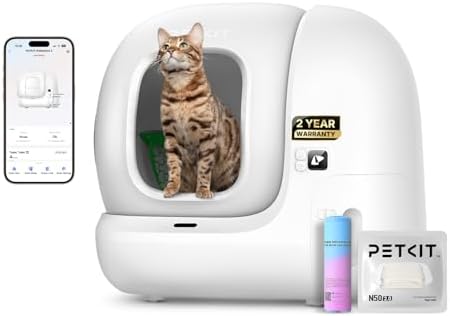
- PETKIT PuraMax 2 automatic self-cleaning cat litter box, basic bundle includes PETKIT PuraMax 2 upgraded automatic cat l…
- No Mess & Leakage-Free: With a patented seamless ShieldBase for 360° sealing, the upgraded cylinder ensures mess-free ma…
- Smart App Control: 2.4GHz enabled, all-in-one app for holistic toilet data and remote control. With the PETKIT smart app…
The PuraMax 2 has a 7-liter waste bin, which PETKIT says can handle up to about 15 days of waste in a single-cat household; in multi-cat homes, expect to empty it more often. It connects to the PETKIT app for real-time visit notifications, waste bin status, and — notably — per-cat weight and usage tracking aimed at flagging early signs of urinary issues across multiple cats. A Kitten Protection Mode disables auto-cleaning for underweight cats, which is a useful safety detail if you have a mixed-age household.
Self-Cleaning Litter Boxes: A Complete Guide for Discerning Cat Owners Compared to Litter-Robot, the PuraMax 2‘s smaller drawer means more frequent emptying in busy multi-cat homes, but its compact footprint and multi-cat health dashboard make it a strong complementary unit rather than necessarily a standalone solution for three or more cats.
ScoopFree Crystal Classic (PetSafe)
The ScoopFree Crystal Classic Self–Cleaning Litter Box takes a different approach entirely. It’s a rake-based system built around PetSafe’s proprietary, disposable crystal litter trays rather than standard clumping litter. The rake periodically sweeps waste into a covered trap, and crystal litter is genuinely effective at locking in moisture and odor — it’s a strong choice for owners who want to avoid scooping and clumping litter altogether.

- Automatically Removes Waste: Enjoy weeks without scooping as the PetSafe Crystal Pro Legacy manages your cat’s litter ef…
- Unbeatable Odor Control: Crystal litter absorbs urine and dries solid waste; includes a disposable tray with ScoopFree C…
- No More Messy Floors: Low-tracking, 99% dust-free crystals keep your home clean and don’t adhere to your cat’s paws
The trade-off is flexibility: ScoopFree’s current lineup is built specifically around crystal litter trays, not clumping litter, so it’s not a fit for cats who strongly prefer a traditional clay or clumping texture. PetSafe’s broader automatic lineup is currently dominated by this rake-and-crystal-tray approach rather than rotating-drum designs.
Other PetSafe automatic options
Beyond the Crystal Classic, PetSafe’s current automatic offerings are primarily variations on the same rake-based, crystal-tray mechanism (including hooded and “Ultra” versions). If you’re comparing brands and want a rotating-drum design instead, that’s where Whisker and PETKIT’s globe- and bin-style units come in — PetSafe’s current catalog doesn’t really compete in that category. Always check waste capacity and cat-count recommendations for the specific model you’re considering, since not every unit is rated for multiple cats.
How many cats can use one litter box?
There’s no single answer, but veterinary and behavior guidelines are consistent: AAHA/AAFP feline life stage guidelines recommend one litter box per cat plus one additional box. A high-capacity automatic litter box with a large waste drawer can serve as a practical compromise when you’re short on space, but it’s not a substitute for the guideline — it just makes stretching it a little safer.
Manufacturer cat-count ratings are a useful data point, not a final word: Litter-Robot 4 is marketed for up to four cats, and Litter-Robot 5/5 Pro for up to five. These numbers reflect mechanical capacity, not behavioral comfort.
Watch your cats for signs of stress — avoidance of the box, elimination outside it, or changes in litter box frequency that could signal urinary tract issues — and add another box if needed.
Managing odor and cleanliness in multi-cat litter setups
To keep odor under control in a multi-cat home:
- Choose a unit with a sealed waste drawer and replace carbon filters on schedule.
- Match litter type to your cats’ preferences: crystal litter (ScoopFree) excels at locking in moisture and odor, while clumping litter (Litter-Robot, PETKIT) tends to be preferred by more cats.
- Keep litter level adequate — too little increases odor concentration, too much fills the waste drawer faster.
- Empty the waste drawer on the schedule appropriate for your cat count; a larger drawer reduces frequency but doesn’t eliminate the task.
- Place units in ventilated areas and consider supplemental odor absorbers nearby.
Practical tips for multi-cat owners
A little patience during setup and ongoing attention to maintenance makes the biggest difference in whether a self-cleaning system actually works for your household long-term.
- Introduce new systems gradually. Cats can be wary of automatic cleaning cycles. Keep an old litter box available alongside the new unit until everyone’s comfortable.
- Combine box types. Keep at least one traditional tray alongside a self-cleaning model if you have shy cats or kittens.
- Match litter to your cats’ preferences. Some cats tolerate crystal litter fine; others strongly prefer clumping clay. Don’t assume one system will work for every cat in the house.
- Don’t skip manual maintenance. Even the best automatic systems benefit from periodic deep cleaning to clear litter dust and residue.
- Use health tracking as an early-warning system, not a diagnosis. Weight and usage tracking from the Whisker or PETKIT apps can flag patterns worth mentioning to your vet — they’re not a substitute for veterinary care.
Common concerns and solutions
What are the disadvantages of an automatic litter box? The main trade-offs are upfront cost (multi-cat-capable units typically run $400–$700) and reliance on electricity.
There’s also a learning curve for cats who are wary of motion or noise. Crystal-tray systems like ScoopFree carry an ongoing cost for proprietary litter, and any motorized unit has more that can mechanically go wrong than a basic tray. None of these are dealbreakers for most multi-cat households, but they’re worth weighing against the time saved.
Will multiple or larger cats damage automatic systems?
Reputable units like Litter-Robot and PuraMax 2 are built with anti-pinch mechanisms and sturdy materials to accommodate larger cats, but check entrance dimensions and weight limits if you have an especially large cat.
Does automatic cleaning scatter litter? High-walled or covered designs help minimize scatter and dust; this varies by model, so check reviews for your specific unit.
Are replacement parts and specialized litter easy to find? Litter-Robot and PETKIT both support widely available clumping litter. ScoopFree requires its own crystal litter trays, which are sold directly and through major retailers but represent an ongoing, brand-specific cost.
Final recommendations
For multi-cat households, prioritize automatic litter boxes with large waste drawers, proven sensor reliability, and odor control suited to your cats’ litter preferences.
The Litter-Robot 4 remains a dependable, well-tested choice for most multi-cat homes, while the Litter-Robot 5 Pro adds newer health-tracking features for owners who want more detailed per-cat insights.
The PETKIT PuraMax 2 is a strong, more compact option — especially as a second unit — with genuinely useful multi-cat health tracking. ScoopFree’s Crystal Classic is the right call if you want to avoid clumping litter entirely and don’t mind an ongoing cost for proprietary litter trays.
Whichever system you choose, pair it with regular manual maintenance, attentive monitoring of your cats’ litter box habits, and realistic expectations about what “automatic” can and can’t replace — including the basic guidance on how many boxes your household actually needs.