
Affiliate Disclosure
Cat & Whisker participates in the Amazon Associates Program. We may earn a commission on qualifying purchases — at no extra cost to you. We only recommend products we’d genuinely put in front of our own cats. Read our full disclosure policy.
The best automatic litter boxes for busy professionals are the Litter-Robot 4s. This is Whisker’s proven, fully-supported robot litter box, starting at $699, with free app monitoring and enough waste capacity to go roughly one to two weeks between empties for one cat, and no official upper weight limit. If budget matters more than interval length, the PETKIT PuraMax 2 delivers strong remote monitoring at around $299. And if you want the simplest possible routine with the longest stated interval on the market, the ScoopFree Crystal Classic uses disposable crystal trays that last 20–30 days for a single cat. This 2026 comparison breaks down how each model works, what maintenance actually looks like, and how to choose between them.
What are the benefits of using an automatic litter box?
For busy owners, the main benefit is time. A self-cleaning litter box automates the daily scooping routine and replaces it with occasional maintenance — emptying a waste drawer every week or two, or swapping a disposable crystal tray once a month. That shift matters when your schedule includes late nights and frequent travel.
Odor control is the other major benefit. Automatic litter boxes seal waste away shortly after each cleaning cycle rather than leaving it sitting in an open litter bed, which means litter box odors stay contained between maintenance visits. Traditional litter box owners who scoop daily still deal with odor buildup between scoops; automatic boxes close that gap almost entirely.
App-connected models also give you visibility into your cat’s litter box usage patterns, which can surface early health signals — changes in frequency or weight that might otherwise go unnoticed until a costly visit to your vet.
How do automatic litter boxes work?
Automatic litter boxes use sensors to detect when your cat exits, then run a cleaning cycle that separates waste from clean litter and deposits it into a sealed drawer or tray. You never scoop — you only empty the waste container when it fills, top up the litter level occasionally, and respond to app alerts.
The mechanism varies by model. Litter-Robot 4 uses a rotating globe that sifts clumping clay litter and drops dirty litter into a sealed waste drawer below. PETKIT PuraMax 2 uses a rotating drum with a built-in waste bin. ScoopFree Crystal Classic uses a motorized rake that pushes waste across the silica gel litter bed into a covered compartment at one end of a disposable tray. In each case the box handles the daily work; you handle the periodic maintenance.
One thing automatic litter boxes don’t fully eliminate is litter tracking — cats still carry litter out on their paws. A litter mat placed at the box entrance helps catch tracked litter before it spreads across the floor, and is worth adding to any automatic litter box setup.
What features should I look for in an automatic litter box?
Key Features to Consider in Automatic Litter Boxes
The most important features for busy professionals are maintenance interval, waste capacity, and app monitoring.
Maintenance interval tells you how many days the box can run before you need to empty it — ranging from about 5 days to 30 days depending on the model and how many cats use it. Match the interval to your typical time away from home.
Waste capacity sets the ceiling on that interval. A larger waste drawer or bin means more room before it fills. Large cats and multiple cats produce more waste per day and shorten whatever interval the manufacturer advertises.
App monitoring lets you check on the box remotely and receive alerts when the waste bin is full or a cycle error occurs — especially valuable when you’re traveling and can’t physically check the litter box.
Other factors worth considering: cat weight limit, litter type compatibility (clumping clay litter vs. crystal or silica gel litter), noise level during the cleaning cycle, whether the design is open-top or enclosed, and whether ongoing costs include a subscription or consumable trays.
What are the differences between popular automatic litter box models like Litter-Robot and PETKIT?
The three strongest automatic litter boxes for busy professionals in 2026 are Litter-Robot 4, PETKIT PuraMax 2, and ScoopFree Crystal Classic. Here’s how they compare on the specs that matter most for hands-off ownership.
| Litter-Robot 4 | PETKIT PuraMax 2 | ScoopFree Crystal Classic | |
|---|---|---|---|
| Price | Starts at $699 (Whisker); also sold via Amazon bundles, pricing varies | ~$299 | ~$120–$180 |
| Interval (1 cat) | ~1–2 weeks between empties | Up to 15 claimed; 3–5 typical | 20–30 days |
| Interval (2 cats) | ~3–7 days between empties | Plan for 3–5 days | 10–15 days |
| Max cat weight | Min. 3 lb; no official upper limit; multi-cat friendly (up to 4 cats) | 22 lbs | Not stated |
| Interior space | ~19″ W x 18″ D, ~15.7–17″ headroom; 15.75″ x 15.75″ entry | 18.9″ x 20.5″ chamber | Open tray |
| Litter type | Clumping clay | Clumping clay | Crystal / silica gel |
| App monitoring | Whisker app, free | Remote control, fill alerts | None |
| Subscription | Whisker+ optional | None disclosed | None |
| Best for | Best overall | Remote monitoring | Longest interval |
A note on the newest Litter-Robot: Whisker’s latest model, the Litter-Robot 5 Pro, is currently sold exclusively through Whisker.com and isn’t available through Amazon or other retail channels. We’ll revisit it here once it’s available through a broader retail channel — for now, Litter-Robot 4 remains the practical pick for hands-off, app-connected cleaning.
What are the best automatic litter boxes for busy professionals?
Litter-Robot 4 — best overall
Litter-Robot 4 is the best overall automatic litter box for busy professionals. It’s Whisker’s proven, fully-supported robot litter box — the same rotating-globe mechanism and sealed waste drawer design the brand is known for, with free app monitoring included standard: remote control, visit and cycle tracking, and SmartScale weight-based cat identification and trend tracking, no subscription required. There’s no official upper weight limit, and Whisker positions LR4 as multi-cat friendly for up to four cats sharing one unit. Waste drawer intervals run roughly one to two weeks for a single cat and three to seven days for two, per Whisker’s own maintenance guidance. Starting at $699, it’s a real investment, but for a professional who wants a set-it-and-mostly-forget-it robot litter box with a real multi-year track record behind it, LR4 delivers a dependable, well-reviewed experience without paying early-adopter prices for the newest hardware. An optional Whisker+ subscription adds daily activity recaps and up to two years of usage history, but it’s not required to get the core hands-off experience.

- SELF-CLEANING LITTER BOX: Never scoop again with Litter-Robot 4 – the automatic, self-cleaning cat litter box. The paten…
- MONITOR + CONTROL VIA APP: Control the smart litter box straight from the Whisker app. Monitor waste and litter levels i…
- REDUCES LITTER BOX ODORS: The automatic clean cycle and odor-absorbing carbon filters or optional OdorTrap Packs signifi…
PETKIT PuraMax 2 — best for remote monitoring
At around $299, PETKIT PuraMax 2 is the best choice for busy owners who prioritize live status updates over raw interval length. Its app provides remote control, real-time fill-level alerts, and usage tracking — so instead of guessing whether the bin needs attention, your phone tells you. Plan maintenance around the 3–5 day real-world range rather than the advertised 15 days, and note the 22 lb weight ceiling if you have a larger cat. For professionals who travel frequently and want smart litter box monitoring at a fraction of a premium robot’s cost, PuraMax 2 hits the sweet spot of value and visibility.
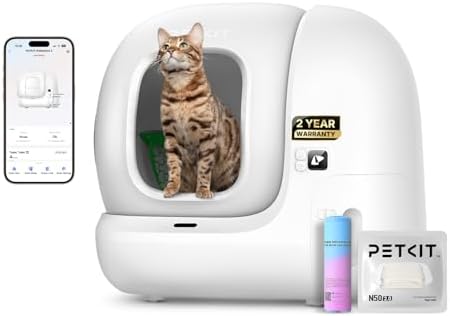
- PETKIT PuraMax 2 automatic self-cleaning cat litter box, basic bundle includes PETKIT PuraMax 2 upgraded automatic cat l…
- No Mess & Leakage-Free: With a patented seamless ShieldBase for 360° sealing, the upgraded cylinder ensures mess-free ma…
- Smart App Control: 2.4GHz enabled, all-in-one app for holistic toilet data and remote control. With the PETKIT smart app…
ScoopFree Crystal Classic — best for simplicity
ScoopFree Crystal Classic is the lowest-friction path into self-cleaning litter boxes, priced at $120–$180. It uses disposable crystal litter trays you replace every 20–30 days for a single cat — no waste drawer to empty, no app required, no subscription. Maintenance becomes a scheduled calendar swap rather than a reactive chore. The trade-off is no smart monitoring and ongoing tray costs of roughly $240–$300 per year. For a busy owner with one average-sized cat who wants the longest stated interval and the simplest routine, it’s a compelling entry point into automatic litter boxes.

- Automatically Removes Waste: Enjoy weeks without scooping as the PetSafe Crystal Pro Legacy manages your cat’s litter ef…
- Unbeatable Odor Control: Crystal litter absorbs urine and dries solid waste; includes a disposable tray with ScoopFree C…
- No More Messy Floors: Low-tracking, 99% dust-free crystals keep your home clean and don’t adhere to your cat’s paws
How do I choose the right automatic litter box for my cat and home?
Start with your cat’s size and the number of cats in your household, then match those to the intervals and weight limits above.
One cat under 15 lbs
Any of the three options works. ScoopFree Crystal Classic offers the longest interval and lowest upfront cost. Litter-Robot 4 offers the best monitoring and largest waste capacity. PuraMax 2 sits between them on price and features.
One large cat
Litter-Robot 4 is the clear choice — Whisker doesn’t publish an upper weight limit, and the globe’s interior dimensions comfortably accommodate most large domestic cats. PETKIT PuraMax 2 covers cats up to 22 lbs. ScoopFree has no stated weight limit but is not designed with larger cats in mind.
Two or more cats
Litter-Robot 4‘s waste drawer gives you the most buffer with multiple cats. One litter box per cat is the traditional rule of thumb; with automatic boxes many owners successfully use one box for two cats, but intervals shorten accordingly.
Budget is the priority
PuraMax 2 at or about $299 gives you automation and app monitoring at a fraction of a premium robot’s price. ScoopFree at $120–$180 is the cheapest entry point, with ongoing tray costs to factor in over time.
What are the maintenance requirements for automatic litter boxes?
All three boxes eliminate daily scooping, but each requires a different type of periodic maintenance.
Litter-Robot 4 requires emptying the waste drawer roughly every one to two weeks for one cat, or every three to seven days for two, per Whisker’s own maintenance guidance, plus topping up clumping clay litter as it depletes after cleaning cycles. Whisker recommends a basic globe wipe-down every one to three months and a full deep clean at least every three months, more often in multi-cat or high-usage households. A litter mat at the entrance helps reduce litter tracking between cleanings.
PETKIT PuraMax 2 requires emptying the 7L waste bin every 3–5 days in typical use, topping up clumping litter, and periodic cleaning of the drum and sensors. App alerts notify you when the bin is full so you’re never caught off guard.
ScoopFree Crystal Classic requires replacing the entire disposable crystal tray every 20–30 days for one cat — no waste drawer to empty and no litter level to monitor. The tray swap is the entire maintenance routine, with replacement trays running roughly $20–$25 each. The silica gel litter absorbs moisture and controls litter box odors without clumping, which is why the tray can last so much longer than a traditional litter box setup.
Are automatic litter boxes safe and good for cats?
Yes, when set up correctly and maintained per manufacturer guidance. All three boxes use sensor systems — weight detection, infrared, or both — designed to prevent the cleaning cycle from running while a cat is inside. Veterinary professionals who review these products generally consider them safe for healthy cats.
Cats with arthritis, injury-related mobility limitations, sensory decline, or advanced age may need a litter box with easy access and low sides, so enclosed or high-entry automatic models like Litter-Robot‘s globe design may be less suitable for some cats than an open-top self-cleaning litter box. Consider your cat’s physical condition alongside the other specs before choosing between them. The main behavioral consideration is acclimation. Whisker reports that most cats begin using a Litter-Robot within a few days to about a week, with the large majority of cats acclimating overall. General transition guidance for automatic litter boxes commonly allows up to two weeks. Individual acceptance varies, so keep a standard litter box available during the transition period just in case.
How do I introduce my cat to an automatic litter box?
Place the new automatic litter box near the old litter box and leave both available. Start with a longer delay cycle so the box doesn’t run immediately after every use — the movement and sound of the cleaning cycle can startle a cat encountering it for the first time. Let your cat explore at their own pace before you phase out the old box.
Once your cat uses the new box consistently, gradually move the old litter box away. If your cat keeps on resisting beyond two weeks, slow the process and try running cleaning cycles only when your cat isn’t nearby. Forcing the transition by removing the traditional litter box too quickly is the most common mistake owners make during acclimation.
What is the cost-benefit of an automatic litter box for busy owners?
The upfront cost of the best automatic litter boxes is real, and ScoopFree‘s tray costs add up to $240–$300 per year. But for a busy professional, the calculation is less about sticker price and more about what you’re buying back: the daily mental load of remembering to scoop, the litter box odors that build when you don’t, and the uncertainty of leaving town without knowing whether the box will hold.
A properly set-up automatic litter box with a fresh waste drawer or new crystal tray can manage a long weekend away without intervention. App alerts from Litter-Robot 4 or PuraMax 2 keep you informed from the road. If a premium robot litter box is too high a starting point, PuraMax 2 at $299 delivers automation and monitoring at a price that’s much easier to justify. ScoopFree Crystal Classic at $120–$180 is the lowest-risk way to test whether your cat will accept self-cleaning before committing to a premium robot litter box.
Self-Cleaning Litter Boxes: A Complete Guide for Discerning Cat Owners