
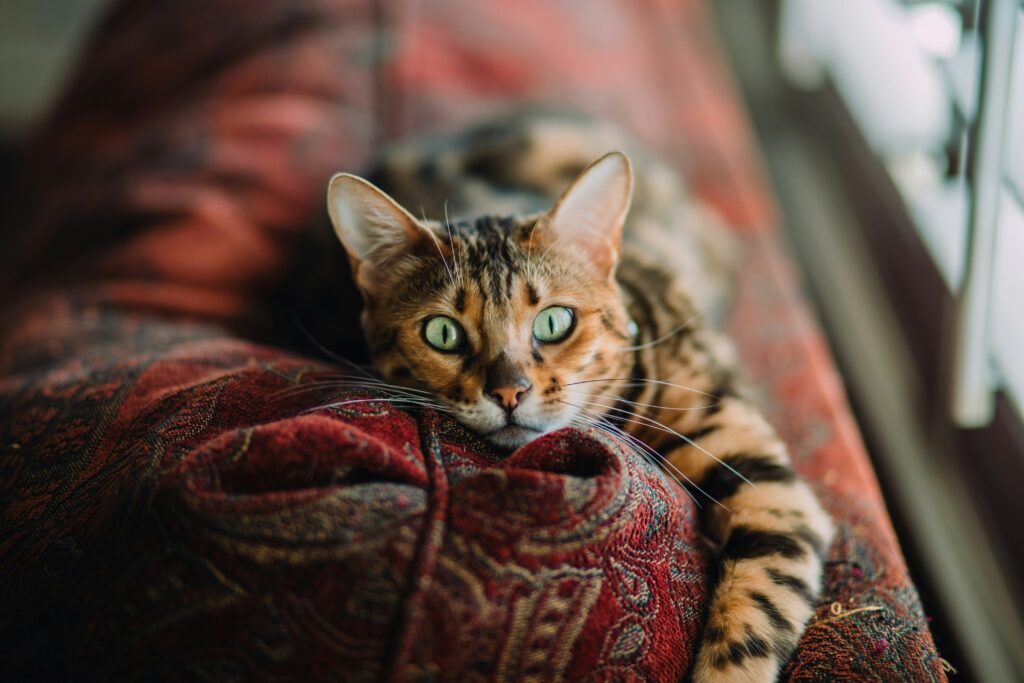
A Bengal is a medium to large cat with an athletic, muscular build, a short-haired spotted or marbled coat, and a confident, curious temperament. Bengal cat personality is much of the appeal: active and playful, people-oriented, and given to climbing to the highest perch in the room. Much of what circulates about the breed, though, is closer to breeder lore than evidence, from how big Bengals get to how long they live. This guide sticks to what The International Cat Association (TICA), the Cat Fanciers’ Association (CFA), veterinary genetics labs, and peer-reviewed research support, and says so where the evidence runs out.
| Bengal Cats | Bengal at a glance |
|---|---|
| Size | Medium-to-large; TICA lists a broad adult range of 6–15 lb (2.7–6.8 kg), males generally larger |
| Coat | Spotted (often rosetted) or marbled, with an optional “glitter” sheen |
| Colors | Brown/black tabby, snow, and silver at the core; blue and others vary by registry |
| Temperament | Confident, curious, athletic, people-oriented |
| Lifespan | Commonly quoted at 12–16 years; one clinical study estimated lower (see below) |
| Health screening | HCM (echocardiography); PRA-b and PK deficiency (DNA tests) |
What are Bengal cat characteristics?
Four things define the Bengal cat breed: a muscular, athletic build, a patterned coat, a people-oriented and curious temperament, and an energy level that shapes how you set up your home.
The Bengal was developed by crossing domestic cats with the wild Asian leopard cat, in a breeding program Jean Mill began in the early 1980s. That origin makes it a hybrid cat on paper, but today’s registered Bengals are domestic house cats, and TICA describes the breeding goal as a loving, dependable temperament with a striking coat.
How big do Bengal cats get?
TICA’s breed profile gives a broad adult range of 6–15 lb (2.7–6.8 kg), with males generally larger than females. Neither TICA nor CFA sets sex-specific weight limits in the standard. Both describe conformation, a medium-to-large, heavily muscled cat, rather than a target number on the scale. The tidy “males 10–15 lb, females 8–12 lb” figures online are convenient estimates, not standards.
Many Bengals keep filling out through roughly their second year, but published standards set no formal adult-maturity age. Body condition matters more than any single number, and your veterinarian can show you what a healthy weight looks like on your cat.
What do Bengal coats look like?
Bengal coats come in two core patterns: a spotted coat, often rosetted, and a marbled coat. TICA’s standard lists spotted, marbled, charcoal spotted, and charcoal marbled. In the spotted pattern, TICA prefers rosettes with two distinct shades, though single spots are permitted. CFA describes marbling as a modified classic tabby with horizontal, diagonal, or random flow, not the bull’s-eye swirl of an ordinary classic tabby. Both registries treat charcoal as a darker pattern effect, not a separate color.
“Glitter” is an iridescent shimmer at the tips of the hairs. It’s optional under TICA’s standard, which prefers neither glittered nor non-glittered coats. A Stanford-led genomic study linked it to a mutation in the FGFR2 gene and reported that it traces to domestic-cat ancestry, not the Asian leopard cat. It’s an effect of hair structure and light, not actual glitter. Stanford Medicine’s summary is a good read on this matter.
What colors do Bengal cats come in?
TICA’s Bengal colors cover brown/black tabby (the classic look, in varying shades of brown), the snow colors (seal lynx point, seal mink, and seal sepia), and their silver counterparts.
- Snow Bengals range from ivory to cream to light tan, with the spotted or marbled marking still visible. Snow is not solid white. Neither registry lists a solid-white Bengal color, so the “white Bengal” people search for is generally a snow Bengal.
- Silver is accepted by both registries.
- Blue is listed by CFA. The TICA Bengal color list we reviewed doesn’t include it.
- Black (melanistic) Bengals are placed by CFA in AOV (Any Other Variety), and TICA’s Bengal list doesn’t include melanistic either.
Registry status affects show eligibility, not a cat’s worth as a companion.
Do Bengal cats need much grooming?
Less than a longhaired cat, but not none. A Bengal’s fur is super soft: TICA describes the short coat as dense, luxurious, and silky to the touch, and CFA calls it soft and luxurious with minimal resilience, meaning it lies smooth against the body. That’s why Bengals are often said to require minimal grooming, which holds up against longhaired breeds whose long, silky, or curly coats need daily brushing. But neither registry assigns Bengals a formal shedding level, and “Bengals barely shed” is breeder lore, not a verified fact. They shed like other shorthaired cats.
A sensible routine is a brief weekly brush or grooming-mitt session to remove loose hair, with more sessions during heavier seasonal shedding if your cat tolerates it. TICA recommends brushing shorthaired cats at least weekly, and a stiff-bristle brush suits short coats. Use the time for a quick check of the skin and coat every few days. Healthy adult cats rarely need baths, and a Bengal’s love of water play doesn’t change that. If a bath is ever needed, use a cat-formulated shampoo, never a human one.
A healthy coat should look clean and glossy, and a complete, balanced diet plus routine care keeps the coat in top condition. A dull, patchy, flaky, or itchy coat can point to skin disease, parasites, illness, pain, or reduced self-grooming, so persistent changes call for a veterinary visit, not a new supplement. No supplement or “Bengal formula” has been shown to make a coat silkier or glittered. Glitter is a genetic coat trait, not a feeding outcome.
Beyond the coat, Bengals need the same basics as any cat: scratching surfaces, nail trims as needed (TICA suggests every 2–4 weeks), and gentle tooth-brushing started early (daily is ideal, and AAHA notes weekly beats none). Check the ears without routinely cleaning them, since persistent debris, odor, or discharge is a reason to call your vet. Introduce handling gradually so these routines stay low-stress.
What is a Bengal cat’s temperament and personality like?
TICA describes Bengals as attentive, loving, social, confident, curious, and playful, ranging from “extroverted and busy” to more naturally introverted. CFA calls them confident, curious, and athletic. Those personality traits describe a cat that wants to be involved with its people: friendly and affectionate by the registries’ account, and likely to want a real share of your attention as well as physical outlets.
The best Bengal-specific behavioral data is a 2021 owner survey in the Journal of Veterinary Behavior. Owners reported climbing in 89.5% of their Bengals, vocalizing in 88.7%, water play in 79.7%, and hunting behavior in 78.9%. Owners generally didn’t consider these behaviors problems, though vocalizing was the one most often called problematic. The survey relied on owner reports and didn’t compare Bengals with other breeds, so read these as tendencies, not guarantees. Vocalization was the behavior owners most often called problematic. A Bengal’s meow is part of the package, and “Bengals are loud” is a common refrain, though the survey didn’t compare them with other breeds.
You’ll also hear that Bengals are highly intelligent cats that will play fetch or walk on a leash. Individual cats may learn to play fetch or accept going for walks on a harness, and “highly intelligent” is a popular description, but neither the breed standards nor the research we reviewed establishes trainability as a breed trait. Compatibility with children and other pets depends on the individual cat’s early socialization, your household, and supervision. If a habit like vocalization becomes a problem, a veterinarian or certified cat behaviorist can help.
How much energy do Bengal cats have?
Expect an agile, athletic cat that treats your home as terrain, though no veterinary source sets a Bengal-specific exercise quota. The often-repeated “two to three hours of play a day” isn’t backed by a validated source. What veterinary guidance does support, for every cat, is the AAFP/ISFM environmental-needs framework. For a cat that leans athletic, good cat care built on it looks like this:
- Vertical territory: stable cat trees, a window perch, shelves, or wall steps.
- Predatory playtime: interactive sessions where the cat can stalk, chase, pounce, and bat a toy with a paw, with toys and timing varied to stimulate a curious mind.
- Active feeding: food puzzles or scatter feeding, when medically appropriate.
- Distributed resources: separate feeding, water, litter, scratching, and resting spots, especially in multi-cat homes.
Exercise wheels are an optional tool, not a requirement. No major feline veterinary guideline specifically recommends them, and no validated safety or sizing standard exists. If you try one, choose a stable model, let the cat approach it voluntarily, and supervise early use.
What are F1, F2, F3, and F4 Bengals?
Breeder listings label cats F1, F2, F3, or F4. F-numbers count generations from the Asian leopard cat, and an F1 has a leopard-cat parent. TICA registers the earliest crosses as Foundation Bengals (F1, 2G, and 3G in its wording), which aren’t eligible for show, and only the females are used as breeding cats.
Beyond that, be cautious. We found no sound study showing that generation predicts adult size or temperament, and TICA itself stresses individual variation. The claim that early generations are “wilder” comes from breeder and retailer content, not research. You’ll also see “SBT,” a pedigree-status term, not a personality guarantee. Whether you’re considering a Bengal kitten or an adult cat, judge the individual cat, its socialization, and its breeder’s practices, not the F-number alone.
Are Bengal cats hypoallergenic?
No. No recognized authority considers any cat breed hypoallergenic. The main allergen, a protein called Fel d 1, is a matter of the cat, not coat length, so a short, sleek Bengal coat doesn’t solve it. Individual reactions vary, so spend time with the specific cat before you commit. Are Any Cat Breeds Really Hypoallergenic?
How long do Bengal cats live?
A commonly quoted lifespan is 12–16 years, but that’s a consumer-guide estimate, not a Bengal-specific survival study. One peer-reviewed clinical-record analysis in the Journal of Feline Medicine and Surgery estimated Bengal life expectancy at birth at 8.51 years. That estimate rested on only 73 cats and includes cats lost young, so it isn’t an individual prognosis. Treat the two figures as the honest range of the evidence, not a promise either way.
What health conditions affect Bengal cats?
Sources often describe Bengals as generally healthy, but three conditions matter most, and responsible breeders screen for them.
- Hypertrophic cardiomyopathy (HCM) is documented in Bengals; Cornell’s Feline Health Center lists them among the more affected breeds. Echocardiography is the established diagnostic tool. No fully validated Bengal-specific predictive DNA test was confirmed, and a normal scan reflects the cat’s status on that day, not a lifetime guarantee.
- Progressive retinal atrophy (PRA-b) is a documented autosomal recessive retinal disease that can lead to blindness. UC Davis VGL offers a DNA test.
- PK deficiency is an inherited hemolytic anemia. UC Davis VGL tests for it, including a combined Bengal panel with PRA-b. A negative result covers that tested variant only, not anemia from every cause.
If you’re buying from a breeder, ask what screening the parents have had and ask to see the documentation. Your veterinarian is the right partner for anything specific to your cat.
Is a Bengal cat the right fit for your home?
A Bengal suits cat parents who treat the environment as part of cat care: vertical space, daily interactive play, and the attention they need. If you’d like a calm, low-demand lap companion, another breed will likely fit better. If you enjoy a curious, engaged cat and you’ll invest in the setup, a Bengal can be a rewarding match. Read the individual cat, not just the breed. How Many Breeds of Cats Are There?
FAQ
Are Bengal cats domestic or wild?
Domestic. Bengals descend from domestic cats crossed with the Asian leopard cat, and TICA’s goal is a loving, dependable, domestic temperament. Early-generation Foundation cats are simply the closest crosses in a pedigree.
Are white Bengal cats real?
Not as solid white. Neither TICA nor CFA lists a solid-white Bengal color. “White” usually means a snow Bengal, a light ivory-to-cream cat with visible markings.
Do Bengal cats like water?
Many do. In the owner survey above, 79.7% reported water play, which is the sober version of the stories about Bengals that join you in the shower. Individual cats vary, so don’t assume yours will.
Are Bengal cats good with children and other pets?
No breed-level guarantee exists. It depends on the individual cat’s socialization, the children’s behavior, and supervision. Predatory play is common in the breed, so introduce small pets carefully.
How big do Bengal cats get?
TICA lists a broad range of 6–15 lb, with males generally larger. Many keep filling out through roughly their second year.
Do Bengal cats shed?
Yes. Bengals have a short, close-lying coat that generally needs less brushing than a longhaired cat’s, but TICA and CFA assign no formal shedding level, and they shed like other shorthaired cats. A weekly brush helps keep loose hair down.