
Affiliate Disclosure
This article may contain affiliate links. If you purchase through one, Cat & Whisker may earn a commission at no extra cost to you. See our full Affiliate Disclosure for details.
If you’ve spent any time researching cat breeds for allergies, you’ve probably seen the same handful of names come up again and again: Siberian, Balinese, Sphynx, Russian Blue, Devon Rex. The idea is appealing — pick the right breed, and cat allergies stop being a dealbreaker. If you are asking yourself, are any cat breeds really hypoallergenic the honest answer is that there is no such thing as a completely hypoallergenic cat. Every cat breed produces the allergen responsible for most reactions, and no cat is guaranteed to be safe for someone with cat allergies.
If you’re searching for the “best hypoallergenic cat breeds” or the single best cat for allergy sufferers, well, there really isn’t a best pick, because no breed in that category has been shown to reliably trigger fewer allergic reactions than the others.
However, that does not mean that breed reputation is pure myth, and it doesn’t mean that living with a cat is out of the question if you are allergic. This guide covers what actually causes cat allergies, why certain breeds earned a hypoallergenic reputation in the first place, and what really helps if you’re managing mild to moderate allergies and still want to bring a cat into your home.
What actually causes cat allergies?
Cat allergies aren’t caused by fur itself. They are caused by a protein called Fel d 1, produced primarily in a cat’s saliva and sebaceous (skin) glands. Every time a cat grooms, that saliva gets spread across their fur, and from there it sheds into dander, dust, and fabric throughout your home. Somewhere between 90–96% of people with cat allergies react specifically to Fel d 1, which is why it’s the protein nearly every hypoallergenic claim is really about, not fur or shedding.
This matters because it means coat length, shedding, and hair type are not reliable indicators for how allergenic a given cat actually is. A hairless cat still grooms, still produces saliva, and still spreads Fel d 1 across its skin. Hairlessness does not eliminate the allergen, it just removes the fur it might otherwise cling to.
Is there such a thing as a truly hypoallergenic cat breed?
No, not in the sense of a breed that’s safe or symptom-free for someone with cat allergies. Every cat studied to date produces Fel d 1, and no breed has been scientifically shown to be allergen-free. That includes every breed you’ll see on a “hypoallergenic cat breeds” list, hairless breeds included.
What is true is that individual cats vary substantially in how much Fel d 1 they produce, and that variation has more to do with the individual cat (and, notably, whether a male cat is neutered) than with breed. A breed label can point you toward cats that tend to run lower, on average, but it’s not a guarantee for any specific cat.
Why do certain cat breeds have a hypoallergenic reputation?
Several breeds consistently show up on hypoallergenic lists, and while none of them are truly allergen-free, most of the reputations trace back to something real — even if it’s been oversimplified along the way.
| Breed | Why it has the reputation |
|---|---|
| Siberian | Some research has found genetic variation in Siberians related to Fel d 1 production, and anecdotal reports describe lower reactions — though this hasn’t been shown to translate into a reliably lower-allergen cat |
| Balinese | Sometimes called the “long-haired Siamese”; often marketed as lower-shedding, which isn’t the same as lower-allergen |
| Devon Rex & Cornish Rex | Both rex breeds have short, curly coats that shed less visibly, which gets conflated with producing less allergen |
| Sphynx | Hairless, which feels intuitive for allergy sufferers — but hairlessness doesn’t reduce Fel d 1 production, since the allergen comes from saliva and skin, not fur |
| Russian Blue | Anecdotally reported as lower-allergen by some owners, though robust breed-level evidence is limited |
| Bengal | Shows up frequently in hypoallergenic searches and lists, without strong evidence specifically supporting the claim |
| Oriental Shorthair, Javanese, Tonkinese, Burmese | Short or fine coats that shed less, often grouped in with “low-shedding, so lower-allergen” reasoning |
The common thread across nearly all of these: low-shedding or low-visible-fur gets read as low-allergen, and that’s the exact substitution the research does not support. Shedding affects how allergen gets distributed around your home, but it is not a reliable measure of how much Fel d 1 a cat actually produces.
A few of these breeds are worth a quick note on relation and terminology. The Balinese is essentially a long-haired Siamese, sharing much of that breed’s coat and body type — though the Siamese itself isn’t typically marketed as hypoallergenic. And Devon Rex and Cornish Rex are usually grouped together simply as “rex cats,” since both breeds share the same short, curly-coated rex gene mutation, just from different original bloodlines.
Do shedding, coat type, or Fel d 1 production affect cat allergies?
Of the three, only Fel d 1 production actually determines how allergenic a cat is — and it doesn’t track cleanly with the other two. Shedding affects how much dander and loose fur circulate through your home, which can influence your exposure level, but it says nothing about how much Fel d 1 that particular cat produces to begin with. Coat type (long, short, curly, or absent) behaves the same way: it changes how allergen is carried and distributed, not how much of it exists.
What actually drives Fel d 1 output is mostly down to the individual cat. Sex and neuter status make a measurable difference, and individual variation is substantial even within the same breed. That’s why two cats of the same low-shedding breed can affect an allergic owner very differently.
Are hairless cats truly hypoallergenic?
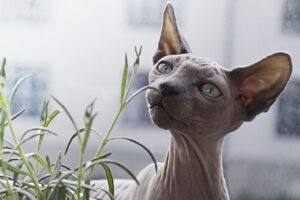
No, not reliably. Since Fel d 1 comes from saliva and skin rather than fur, a hairless breed like the Sphynx still grooms itself, still produces the allergen, and still spreads it onto its own skin and onto anything it touches. Hairlessness may reduce how much allergen clings to loose fur around your home, but it doesn’t lower how much Fel d 1 the cat is actually producing.
What practical tips can help manage cat allergies at home?
If your allergies are mild to moderate and you still want a cat, plenty of people do successfully live with cats — it just takes a genuinely realistic plan, not a hypoallergenic breed. The goal is not eliminating the allergen from your home (that is not realistic even without a cat). It’s reducing your day-to-day exposure enough that symptoms stay manageable.
Make the bedroom a strict cat-free zone. This is the single highest-value change, since you’re spending hours there every night. Keep the cat off the bed and any upholstered bedroom furniture — allergen can still drift in, but keeping the room’s biggest reservoirs cat-free meaningfully lowers your overnight exposure.
Run a HEPA air purifier, ideally in the bedroom or wherever your cat spends the most time. It’s a reasonable, evidence-supported adjunct — not a fix on its own, but worth running consistently.
Vacuum and launder regularly. Fel d 1 settles into carpet, upholstery, and fabric and stays there. A weekly minimum with a HEPA-filter vacuum, along with regular washing of bedding, throws, and cat bedding, keeps those reservoirs from building up. Favor damp-wiping and wet-mopping hard surfaces over dry dusting, which tends to stir allergen back into the air instead of removing it.
Manage direct contact. Wash your hands after petting, avoid letting your cat sleep on your pillow or lick your face, and if you brush your cat regularly, do it outdoors (or have a non-allergic household member handle it) rather than indoors.
Be realistic about bathing. Bathing a cat can temporarily reduce the amount of Fel d 1 on their coat, but the effect doesn’t last — allergen levels tend to rebound within a day or two, and the research doesn’t support a weekly bath as a reliable long-term fix. It’s also worth weighing against your cat’s stress and welfare; frequent bathing isn’t something most cats tolerate well, and it shouldn’t be treated as a routine allergy treatment.
One thing worth knowing if you’re moving out of a home a cat lived in: Fel d 1 is persistent. It can take four to six months or longer for allergen levels in a home to drop to those of a cat-free household, even with intensive cleaning. American Academy of Allergy, Asthma & Immunology (AAAAI)
Does a cat’s sex or neutering status affect allergen production?
For male cats, yes, to a meaningful degree, though it’s not a cure. Research has found that intact male cats produce substantially more Fel d 1 than neutered males, with studies suggesting somewhere in the range of a 75–90% reduction after neutering. That is a real, biologically grounded effect tied to hormones, not breed. Sex alone doesn’t appear to make the same kind of difference; research has not found a meaningful gap between neutered males and females, or between spayed and intact females.
That said, neutering should nor be considered as an allergy treatment on its own. It is a decision that should be made primarily for your cat’s health and welfare, with the allergen reduction as a side benefit rather than the main reason. Neutered males and female cats of any breed still produce Fel d 1 and can still trigger real symptoms.
Can a cat’s diet help reduce allergens?
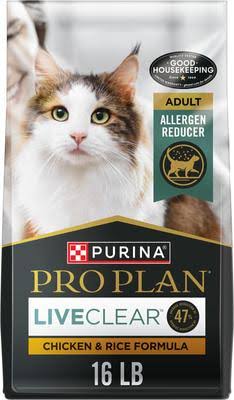
There’s one product worth knowing about here, because unlike most “hypoallergenic” marketing, it actually has peer-reviewed research behind it: Purina Pro Plan LiveClear. It’s a dry cat food formulated with an egg-derived antibody that binds to and neutralizes active Fel d 1 in a cat’s saliva — the idea being that if less active allergen is in the saliva to begin with, less gets spread onto fur and dander during grooming.
Purina’s own research found an average 47% reduction in active Fel d 1 on cats’ hair and dander by around week 10 of daily feeding, with the decline becoming measurable by week 3. That’s a genuinely researched effect, not just marketing language — but it comes with real caveats worth knowing before you decide it’s worth trying:
- The core research behind that 47% figure was funded and conducted by Purina itself, not an independent lab.
- LiveClear neutralizes active Fel d 1 already produced — it doesn’t stop cats from producing the protein in the first place.
- Human studies on whether it actually reduces allergy symptoms are still small and preliminary. One larger real-world study found meaningful improvement in participants’ reported symptoms, but it had no control group, so some of that improvement could reflect other factors.
The realistic way to think about LiveClear: it is a plausible, research-backed layer to add to an allergy-management plan, worth discussing with your vet, given that any diet change should also fit your cat’s individual nutritional needs, not a standalone fix or a way to make a cat “hypoallergenic.”
When should you see a doctor about cat allergies?
Environmental changes and diet adjustments can meaningfully reduce your exposure, but they’re not a substitute for medical care — especially if your symptoms go beyond mild sneezing or watery eyes. See an allergist or your regular doctor if you experience:
- Wheezing, shortness of breath, or chest tightness
- Symptoms that interfere with sleep or daily activity despite taking the steps above
- Uncertainty about whether cats are actually the cause of your symptoms
An allergist can confirm what’s actually triggering your reactions (people with cat allergies often have overlapping sensitivities to dust mites or pollen) and talk through options like antihistamines, nasal treatments, or allergen immunotherapy — none of which should be self-managed without professional guidance, particularly if asthma is involved.
Frequently Asked Questions
Here are quick, direct answers to the questions people most often have about cat allergies and hypoallergenic breeds.
Is any cat breed completely hypoallergenic? No. Every cat breed produces Fel d 1, the protein responsible for most cat allergies. No breed has been scientifically proven to be allergen-free.
Which cat breeds are considered hypoallergenic? Siberian, Balinese, Devon Rex, Cornish Rex, Sphynx, Russian Blue, Bengal, Oriental Shorthair, Tonkinese, Javanese, and Burmese are the breeds most often listed as hypoallergenic — but “considered” reflects reputation and anecdote more than proven science.
Do hairless cats trigger fewer allergies? Not reliably. Fel d 1 comes from a cat’s saliva and skin, not their fur, so a hairless breed like the Sphynx still produces and spreads the allergen.
Does neutering a cat help with allergies? For male cats, yes — neutering is linked to a substantial reduction in Fel d 1 production. It’s not a cure, and cats of any sex or breed still produce some amount of the allergen.
Can someone with mild cat allergies still own a cat? Often, yes. A combination of a cat-free bedroom, HEPA filtration, regular cleaning, and good hygiene habits after handling your cat can make living with a cat manageable for many people with mild to moderate allergies. Anyone with more severe symptoms or asthma should talk to an allergist first.
Choosing honesty over a hypoallergenic myth
If you’re allergy-prone and set on adopting a hypoallergenic cat because a specific breed is marketed that way, it’s worth going in with realistic expectations rather than a guarantee. Spend time with the actual cat you’re considering before committing, ask about its individual history if it’s from a breeder or rescue, and build your allergy-management plan around your home and habits — not around a breed label. That’s a more honest, and ultimately more successful, way to bring a cat into your home if allergies are part of the equation. How Many Breeds of Cats Are There?
NIH/PMC – Fel d 1 and cat allergy review (Journal of Feline Medicine and Surgery)