Affiliate Disclosure
This article may contain affiliate links. If you purchase through one, Cat & Whisker may earn a commission at no extra cost to you. See our full Affiliate Disclosure for details.
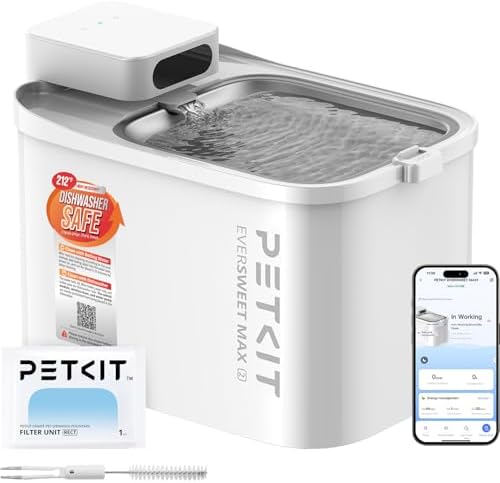
The best cat water fountain is the one your cat actually drinks from and you’ll actually keep clean, and for most homes that means a stainless steel or ceramic bowl rather than plastic. Our top pick is the Pioneer Pet Raindrop Premium Stainless Steel fountain: an 18/8 stainless steel bowl, dishwasher-safe parts, and a pump you can replace for about the price of a bag of treats. The PetSafe Creekside Ceramic is the pick for design-conscious homes, and the PETKIT Eversweet MAX 2 is the cordless pick for anywhere without a convenient outlet.
One thing worth knowing before you shop for a water fountain for cats: “stainless steel” on a water fountain listing doesn’t always mean what you’d assume. Many of the most popular smart fountains pair a stainless drinking tray with a plastic tank that holds most of the water. This guide explains the difference, what the research actually says about fountains and hydration, and what each fountain costs to keep running once you’ve bought it.
Do vets recommend cat water fountains, and do they actually help?
Veterinary sources generally treat fountains as a worthwhile option to try, not a must-have. The Cornell Feline Health Center notes that some cats increase their water intake with a fountain but that preferences vary. The AAFP–AAHA feline life stage guidelines list fountains alongside bowls and dripping water as ways to offer water, while pointing to canned food as the more reliable way to raise intake. The ISFM’s chronic kidney disease guidelines similarly recommend offering varied water sources and feeding a wet diet where possible.
Vets often recommend cat water fountains as something worth trying, and the research explains why the advice stops there. A 2019 study in the Journal of Feline Medicine and Surgery offered 16 cats still, circulating, and free-falling water bowls and found no significant difference in daily water intake between them, and no meaningful improvement in urine measures. A 2010 study found a small apparent increase in water intake from a fountain, but the cats’ urine concentration was no different, which means they weren’t meaningfully better hydrated. A third 2010 study found no group-level preference for flowing water over standing water, although individual cats clearly had preferences of their own.
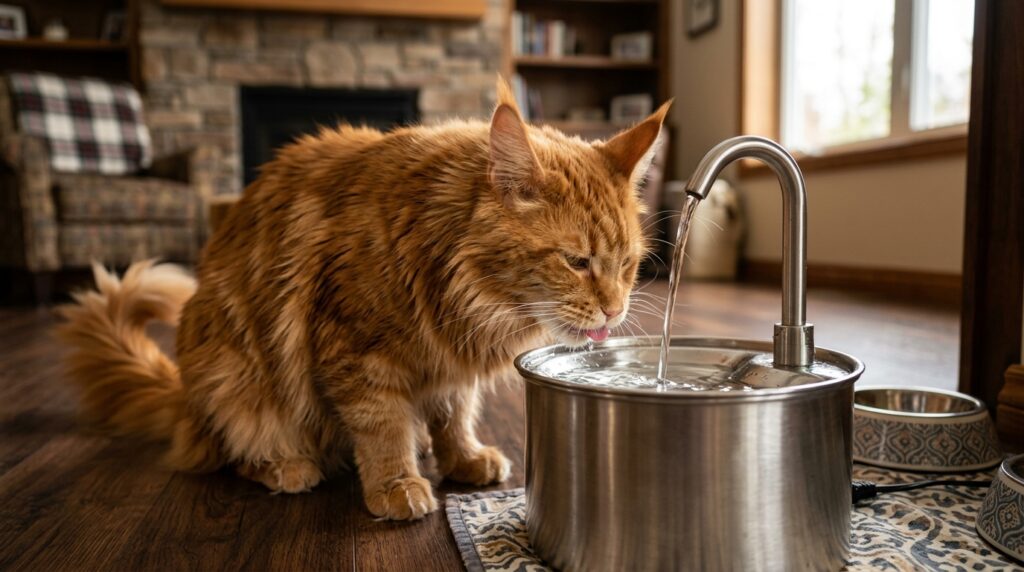
That last point is the useful one. The Cornell Feline Health Center notes that some cats do increase their water intake when offered a fountain, but preferences vary from cat to cat. If your cat paws at the faucet, drinks from the shower, or seems indifferent to a regular water bowl, a fountain is well worth trying. Cat water fountains can help the cats that prefer flowing water. They just aren’t a guaranteed hydration upgrade for every cat.
Why wet food matters more than the fountain
The number that matters is your cat’s total water intake, not how much they drink from any one bowl. Wet cat food can be up to about 80% water, according to Cornell, which is why cats on wet diets often drink less from a bowl while still taking in more water overall. The International Society of Feline Medicine’s chronic kidney disease guidelines likewise recommend feeding a wet diet where possible specifically because it increases water intake.
A fountain works best as a complement to a moisture-rich diet, not a replacement for one. Read our guide on Natural Cat Food.
Hydration, urinary health, and kidneys
Adequate hydration and more dilute urine are well-established parts of managing feline urinary conditions like idiopathic cystitis and certain bladder stones, and Cornell describes good hydration as essential for cats living with chronic kidney disease. What hasn’t been shown is that any fountain prevents urinary or kidney disease on its own. Think of a fountain as supportive equipment, not treatment.
One more thing worth knowing: if your cat suddenly starts drinking noticeably more than usual, that’s a reason to call your vet, not a sign the fountain is working. Increased thirst can be an early sign of kidney disease, diabetes, or hyperthyroidism.
What are the pros and cons of a cat water fountain?
A fountain is a good fit for some cats and some owners, and a poor one for others.
The pros. Cats that prefer flowing water may drink more readily from a fountain than from a still bowl. Filters catch hair and debris between cleanings, and a larger tank means fewer refills than a standard water bowl. Smart models can track how often your cat drinks, which helps you notice changes worth mentioning to your vet.
The cons. Research hasn’t shown that fountains consistently increase water intake across cats. A fountain needs more cleaning than a bowl, including taking the pump apart on a schedule, and a neglected fountain can be less hygienic than a clean bowl. Filters and eventual replacement pumps add ongoing cost. Plug-in models need an outlet, cordless models need charging, and any pump can fail, which is why keeping a regular water bowl out as a backup is a smart habit.
What are the different types of cat water fountains?
Cat water fountains differ in three main ways: what they’re made of, how they’re powered, and how the water flows.
By material: stainless steel, ceramic, or plastic. Material is the biggest factor in how easy a fountain is to keep clean over the years, and it’s more complicated than listings suggest (more on that below).
By power: plug-in fountains run continuously from an outlet. Cordless fountains run on a rechargeable battery, and some, like the PETKIT Eversweet MAX 2, can also run plugged in via USB. Some cordless models save battery with a sensor mode that pumps water only when a cat approaches.
By flow design: water can fall in a sheet over a dome (the Pioneer Raindrop), spill from a tower into a basin (the PetSafe Creekside), come from several adjustable streams at once (the PetSafe Drinkwell 360), or fill a shallow drinking tray from a tank underneath, which is how most smart fountains work. Cats often have a preference, so if yours ignores one style, a different flow may appeal more.
What does “stainless steel” actually mean on a cat water fountain?
It depends on the design, and the difference is easy to miss on a product page for a stainless steel cat fountain.
Traditional fountains like the Pioneer Raindrop and PetSafe Drinkwell 360 Stainless use a stainless steel bowl that holds all of the water. The pump and filter housing are still plastic, as they are in essentially every pet fountain, but the surface holding the water and the surface your cat drinks from are both stainless.
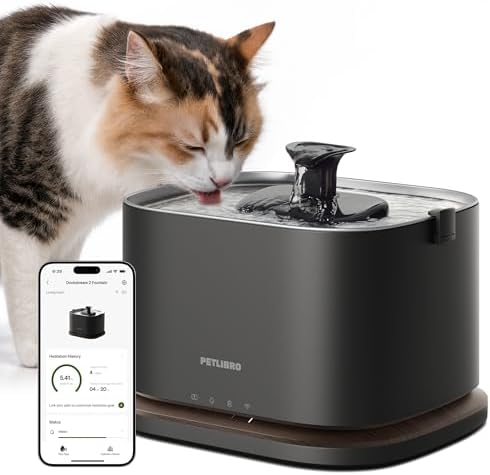
Most smart and cordless fountains use a different construction: a stainless steel drinking tray (where your cat’s chin and tongue actually touch) sitting on top of a food-grade ABS plastic tank that holds most of the water. The PETKIT Eversweet MAX 2 and the PETLIBRO Dockstream 2 are both built this way. A few models flip it: PETKIT’s Eversweet 3 Pro has a stainless steel tank but an ABS drinking tray.
None of this is a defect. Food-grade ABS is a standard, reasonable material for a pet water fountain. But if you chose a stainless steel fountain specifically to keep plastic out of the picture, check the listing for the tank or reservoir material, not just the words “stainless steel.” Our comparison table below spells out exactly which parts are stainless or ceramic for each pick.
Why the drinking surface matters
Stainless steel and ceramic are smooth, durable, and dishwasher-friendly. Plastic can scratch over time, and those scratches give residue and bacteria somewhere to settle. Veterinary sources also note that contact sensitivity to the plastic in some bowls is one possible contributor to feline chin acne, though chin acne has many causes and plastic isn’t proven to cause it in every cat. For that reason, every fountain in this guide uses stainless steel or ceramic where your cat drinks, and popular plastic designs like the Catit Flower Fountain aren’t included.
What should I look for in a cat water fountain?
Beyond material, five things separate a fountain you’ll be glad you bought from one that ends up in a closet.
Is it easy to clean?
This is the single most important feature, and the one most listings bury. Any fountain with a pump, a filter, and wet internal surfaces needs regular disassembly and cleaning. Look for dishwasher-safe parts and a pump that actually comes apart, so you can reach the impeller where slime tends to collect. A fountain that’s easier to clean is a fountain that actually gets cleaned.
What will filters cost over time?
Most fountains use replacement filters on a two- to four-week schedule, and the cost adds up differently by brand (see our cost breakdown at the end of this guide). A filterless cat water fountain sounds like the answer, but filterless designs still have parts to replace or clean on a schedule, so check what the maintenance actually involves before assuming “filterless” means “maintenance-free.”
How quiet is the water pump?
Noise matters more than most people expect, especially if the fountain lives in a bedroom or a small apartment. For a water fountain with quiet operation, some brands publish a decibel rating (PETKIT lists 26 dB or less for the MAX 2), while others, including Pioneer and PetSafe, don’t publish one at all. Treat “whisper quiet” in a listing as marketing unless there’s a number behind it.
Will my cat knock it over?
If your cat likes to paw at water or bat things off counters, stability matters. None of the manufacturers we checked publish a tip-resistance rating, so judge by construction: a heavy fountain with a wide, low base resists tipping better than a tall, narrow one. Ceramic fountains tend to be the heaviest and hardest to push around. Stainless steel is lighter, though a full bowl adds real weight. Placing the fountain against a wall or in a corner makes it harder to shove, a silicone mat underneath keeps it from sliding and catches splashes, and routing the power cord out of paw’s reach keeps a plug-in fountain from being dragged.
Corded or cordless?
A plug-in fountain needs to sit near an outlet, with a cord your cat can reach. A cordless or wireless cat water fountain runs on a rechargeable battery, so you can place it wherever your cat prefers. Watch the terminology here: “wireless pump” usually means the pump has no cable running through the water, but the fountain itself still has to stay plugged in. Only a battery-powered model is truly cordless.
Capacity, water level, and smart features
A larger tank means fewer refills, but also more water sitting between cleanings, so size the fountain to your household rather than going as big as possible. Being able to see the water level at a glance, through a water level window or an app alert when the water level is low, saves you from discovering an empty fountain. A smart cat water fountain can also track how often your cat drinks, which is genuinely useful for spotting changes worth mentioning to your vet. UV sterilization features are harder to judge: we found no independent evidence that UV in a household pet fountain outperforms regular, thorough cleaning.
Comparison table
| Best Cat Fountains | Pioneer Pet Raindrop Stainless | PetSafe Creekside Ceramic | PETKIT Eversweet MAX 2 |
|---|---|---|---|
| Price | $59.99 | $65.99 | $84.99 |
| Capacity | 60 oz (about 1.8 L) | 60 oz (about 1.8 L) | 101 oz (3 L) |
| What’s actually stainless or ceramic | 18/8 stainless steel bowl and stainless top | Ceramic bowl and tower | 304 stainless drinking tray (tank is ABS plastic) |
| Power | Plug-in | Plug-in | Rechargeable battery or USB |
| Dishwasher-safe | Fountain parts (hand-clean the pump) | Ceramic parts, top rack (hand-wash the pump) | Tank, tray, lid, filter holder, outlet pipe |
| Published noise | Not published | Not published | 26 dB or less |
| Filter replacement | Every 2–4 weeks | See current listing | Every 4 weeks |
| Warranty | 1 year | See current listing | 1 year |
| Best for | Most homes with one or two cats | Design-conscious homes | Flexible placement and drinking tracking |
Best cat water fountains of 2026
Here are the three fountains that earned a spot in this guide, and exactly who each one is built for.
Pioneer Pet Raindrop Premium Stainless Steel — best overall
The Raindrop earns the top spot by getting the fundamentals right. Its bowl is 18/8 stainless steel, a grade Pioneer Pet states outright rather than leaving vague, and the stainless top means your cat drinks from metal, not plastic. Water flows down over the top in a gentle sheet into the 60 oz bowl, which is a comfortable size for one or two cats without leaving a large volume of water sitting between cleanings.
Maintenance is refreshingly straightforward. Pioneer Pet describes the fountain as dishwasher safe and recommends a simple schedule: clean the fountain weekly, replace the charcoal filter every two to four weeks, and take the pump apart for cleaning once a month. When the pump eventually wears out, a replacement 12-volt pump costs less than $15 directly from Pioneer, so a worn pump doesn’t mean replacing the whole fountain.
Two trade-offs to know. Pioneer doesn’t publish a noise rating, so we can’t give you a verified decibel figure. And the one-year warranty is voided if the pump isn’t maintained per the manual, which is a good reason to put that monthly pump cleaning on your calendar. There’s no app, no battery, and no UV light here, just a well-made stainless steel cat water fountain that does its job.
Pioneer Pet Raindrop Premium Stainless Steel $59.99
PetSafe Creekside Ceramic — best ceramic cat water fountain
If you’d rather your cat’s fountain look like a piece of pottery than a pet appliance, the Creekside is the pick. Both the bowl and the tower are ceramic, so the surfaces that hold the water and the surface your cat drinks from are glazed ceramic rather than plastic. Water spills from the tower into the 60 oz basin, the same capacity as the Raindrop.
Cleaning is simple: the ceramic components go in the top rack of the dishwasher, and the pump gets washed by hand. As with every fountain here, the pump and filter components themselves are plastic. PetSafe doesn’t publish a noise rating for the Creekside.
Ceramic is heavier than stainless steel, which makes it harder to tip over but a little more work to carry to the sink, and it can chip if dropped. If you like the ceramic approach but want a more sculptural look and slightly more capacity, PetSafe’s Drinkwell Pagoda fountain holds 70 oz and is also top-rack dishwasher safe, apart from the pump.
PetSafe Creekside Ceramic $65.99
PETKIT Eversweet MAX 2 (Cordless/UVC) — best cordless cat water fountain
The MAX 2 solves the problem traditional fountains can’t: it runs on a built-in rechargeable battery, so you can put it where your cat wants to drink rather than where the nearest outlet happens to be. PETKIT claims up to 83 days per charge under its default settings, which assume water flows for about 25 seconds per hour, so expect shorter runtimes in a busy household. It also runs plugged in via USB whenever you prefer.
It’s also the easiest fountain here to clean. PETKIT describes the MAX 2 as fully dishwasher safe, including the tank, tray, lid, filter holder, and outlet pipe. The Bluetooth app tracks how often and how long your cat drinks, and sends reminders for low water, low battery, and filter changes. The pump includes UV-C, which PETKIT says reduces bacterial buildup; we’d treat that as a bonus rather than a reason to clean less often. PETKIT lists noise at 26 dB or less.
The honest caveat is the one from earlier in this guide: the MAX 2 has a 304 stainless steel drinking tray, but its 3 L tank is food-grade ABS plastic. That’s the norm for cordless fountains; no current cordless model we found has a stainless steel reservoir. The warranty is one year.
PETKIT Eversweet MAX 2 $84.99
If you’d rather have Wi-Fi app monitoring, the PETLIBRO Dockstream 2 Smart Cordless Fountain is the strongest alternative. The PETLIBRO Dockstream 2 publishes a quieter 23 dB rating and a longer two-year warranty, and PETLIBRO claims up to 30 days per charge for one cat under its test conditions. The trade-offs are that only its stainless steel tray is dishwasher safe and PETLIBRO recommends replacing its filters every two weeks. Like the MAX 2, it pairs a stainless tray with an ABS tank.
How do I choose the right cat water fountain for my cat?
Match the fountain to your household first, and your décor second.
One or two cats: the Pioneer Raindrop. It’s the most straightforward stainless steel fountain here, with the clearest material claims and the cheapest replacement pump.
Design-first homes: the PetSafe Creekside Ceramic, or the Pagoda if you want a more sculptural piece.
Cats who paw at water or knock things over: the PetSafe Creekside Ceramic. Its weight makes it the hardest of the three picks to push around.
No convenient outlet, or you want drinking data: the PETKIT Eversweet MAX 2, or the PETLIBRO Dockstream 2 if you’d prefer Wi-Fi monitoring and a longer warranty.
Multiple cats (or cats and dogs): consider the PetSafe Drinkwell 360 Stainless. It holds a full gallon (128 oz) in a stainless steel basin and tower, offers one to five adjustable water streams so several animals can drink at once, and PetSafe designs it for multiple-pet households and larger dogs. Its pump comes fully apart for cleaning, and its carbon filters are the least expensive of any fountain we looked at. Even so, a single fountain shouldn’t be the only water source in a multi-cat home. Feline environmental guidelines recommend water in multiple, separate locations so no cat has to share space or get past another cat to drink.
PetSafe Drinkwell 360 Stainless $75.99
How do I keep a cat water fountain clean?
Follow your manufacturer’s schedule, and clean sooner if you see or feel slime.
That slippery film on a fountain’s surfaces is biofilm, a layer of microbes that builds up on any wet surface exposed to saliva, food particles, and debris. There’s no reliable research giving a universal number of hours or days before it forms in a cat fountain, so let the fountain tell you: if you notice slime, debris, odor, or visible buildup, it’s time to clean it, whatever the calendar says.
A thorough cleaning looks like this: unplug the fountain, take it fully apart, wash the bowl and removable parts (in the dishwasher, if your model allows), disassemble the pump and clean the impeller and any narrow channels with a small brush or cotton swab, then replace the filter if it’s due. Between deep cleans, top up with fresh water and keep an eye on the water level daily.
Manufacturer schedules vary. Pioneer Pet recommends cleaning the Raindrop weekly and its pump monthly, while PetSafe recommends cleaning the Drinkwell 360’s pump every two weeks. Both Pioneer and PetSafe say the warranty may be voided if the pump isn’t cleaned as directed, so pump cleaning isn’t optional.
One last habit worth building: keep a regular water bowl out as a backup. If a pump fails or the fountain runs dry while you’re away, your cat still has clean water to drink.
Where should I put a cat water fountain?
Away from food, well away from the litter box, and ideally in more than one place.
The 2013 AAFP and ISFM Feline Environmental Needs Guidelines recommend that food and water be separated from each other, and that toileting areas be kept well apart from other key resources. They don’t give a specific distance, so use common sense: a different spot in the room from the food bowl, and a different room from the litter box if you can manage it.
The same guidelines recommend offering water in multiple locations, especially in multi-cat homes, so every cat can drink without competing for access. Choose a quiet, easy-to-reach spot out of the main foot traffic, and near an outlet unless your fountain is cordless.
FAQ
Is a stainless steel or ceramic cat water fountain better? Both are good choices. Stainless steel is lighter and won’t chip; ceramic is heavier, harder to tip over, and often reads more like décor. Either is easier to keep hygienic over time than plastic, which can scratch.
How often should I change cat water fountain filters? Follow your fountain’s manual. Most manufacturers recommend every two to four weeks: Pioneer and PetSafe both say two to four weeks, PETKIT says every four weeks for the MAX 2, and PETLIBRO recommends every two weeks for the Dockstream 2. Replace sooner if flow slows or the filter looks dirty.
Is a filterless cat water fountain worth it? It can be, but “filterless” doesn’t mean maintenance-free. You’ll still need to clean the fountain regularly and, depending on the design, replace other parts on a schedule. Compare the full maintenance routine, not just whether there’s a filter.
Are UV cat water fountains worth it? UV features are a reasonable bonus, but we found no independent evidence that UV in a household pet fountain works better than regular, thorough cleaning. Don’t let a UV light talk you into cleaning less often.
Can a water fountain replace wet food for hydration? No. Wet food delivers water directly with every meal, and veterinary guidelines consistently point to it as the more reliable way to increase a cat’s total water intake. A fountain is a good complement, not a substitute.
Can one fountain work for multiple cats? A large fountain like the PetSafe Drinkwell 360 Stainless can serve several cats at once, but feline environmental guidelines recommend water in more than one location in multi-cat homes, so plan on at least one additional water source.
What if my cat won’t drink from the fountain? Some cats simply prefer still water. Keep a regular water bowl available alongside the fountain, try a different location, and give your cat time to investigate. If your cat’s overall drinking changes noticeably in either direction, check in with your vet.
What does a cat water fountain really cost to own?
The purchase price is only part of the story. Every fountain here needs replacement filters, and eventually a new pump. Here’s what filters cost per year at each manufacturer’s recommended schedule, based on list prices in September 2026:
| Fountain | Filter schedule | Approx. cost per filter | Approx. filter cost per year |
|---|---|---|---|
| PetSafe Drinkwell 360 Stainless | Every 2–4 weeks (carbon) | $1.25 | $16–33, plus foam prefilters |
| Pioneer Pet Raindrop | Every 2–4 weeks | $3.66 | $48–95 |
| PETKIT Eversweet MAX 2 | Every 4 weeks | $4.00 | About $52 |
| PETLIBRO Dockstream 2 | Every 2 weeks | $3.37–3.75 | $88–98 |
Replacement pumps are the other long-term cost: about $15 for the Raindrop and about $21 for the Drinkwell 360, sold directly by each manufacturer.
A cat water fountain only earns its keep if two things are true: your cat actually drinks from it, and you actually clean it. A well-made stainless steel or ceramic fountain with dishwasher-safe parts makes the second part far easier, and it will outlast a plastic fountain that scratches and stains within a year or two. That’s the real case for spending more here: not a promise of better health outcomes, but a fountain that stays clean, keeps working, and gives a cat who loves flowing water a reason to drink. Kidney Disease in Cats: Symptoms, Causes, Stages & Care Guide