
Affiliate Disclosure
This article may contain affiliate links. If you purchase through one, Cat & Whisker may earn a commission at no extra cost to you. See our full Affiliate Disclosure for details.
The best automatic cat feeder for multi-cat homes is the one that knows which of your cats is eating. Most feeders marketed for two cats simply split one meal between two open bowls, which works only until the faster or bolder cat decides both bowls are theirs. For a multi-cat household, our top pick is the PETLIBRO One RFID, used as one feeder per cat: it dispenses scheduled meals and unlocks its lid only for the cat wearing its tag. For wet food or a prescription diet, the SureFeed Microchip Pet Feeder Connect reads your cat’s implanted microchip. And if your goal is seeing who ate what rather than controlling it, Purina’s new Petivity Smart Feeder tracks up to five cats by facial recognition.
This guide explains the three kinds of multi-cat feeders, which one your feline’s home actually needs, and how to introduce your cats to one without turning mealtime into a new source of stress.
Do vets recommend automatic cat feeders for multi-cat homes?
Veterinary guidance treats them as a useful tool rather than a requirement. The 2021 AAHA Nutrition and Weight Management Guidelines note that automated feeders are useful for controlling food access and amount. What matters most in a multi-cat home is the kind of feeder, because the problem usually isn’t when food appears; it’s who gets it.
Feline veterinary guidance is consistent on this point. The AAFP Feline Behavior Guidelines recommend at least one food bowl per cat to avoid food guarding and hierarchy-related conflict, and note that a more assertive cat can control another cat’s access to food. A shared automatic feeder, however well scheduled, puts every cat’s meal in the same contested spot.
Portion control is the other half of it. The Cornell Feline Health Center describes obesity as the most frequently observed nutritional disorder in domestic cats and identifies free feeding as a major contributing factor. When cats share food, it’s very hard to know how much any one of them is really eating, which makes measured portions only as good as your ability to keep each cat to their own.
There’s also a monitoring benefit that’s easy to overlook. According to AAHA, a sudden decrease or increase in appetite can indicate pain, dental discomfort, illness, or hormonal imbalance, and warrants a call to your veterinarian. In a home where everyone eats from the same bowl, that kind of change in one cat can go unnoticed for days.
What are the different types of automatic cat feeders for multiple cats?
Automatic cat feeders sold for multiple cats fall into three distinct categories, and the product listings rarely make the difference clear.
Dual-bowl feeders
A dual-bowl feeder dispenses one scheduled meal from a shared hopper and divides it between two open bowls. It’s convenient for two cats who eat at their own pace and leave each other’s food alone. It does nothing to stop one cat from finishing both portions, and the two bowls can’t be scheduled or portioned independently.
Access-control feeders (RFID and microchip)
An access-control feeder keeps its bowl covered until it recognizes the right cat, either by an RFID tag on the cat’s collar or by the cat’s implanted microchip. Every other cat finds a closed lid. This is the only type of feeder that protects one cat’s food from another. This would be the right choice for cats with prescription diets, weight-loss plans, or a determined food thief.
Recognition and monitoring feeders
A recognition feeder identifies which cat is eating, usually with a camera, and logs each cat’s intake over time. It gives you per-cat data without collars or tags, but it doesn’t physically stop a cat from eating food meant for someone else. Think of it as visibility, not enforcement.
How do RFID and microchip feeders work in a multi-cat household?
An RFID cat feeder is an access-control feeder that reads a small radio-frequency tag, typically worn on the cat’s collar, and opens only for the cat assigned to it. Some models, like SureFeed, can also read the microchip already implanted in most cats, so no collar is needed.
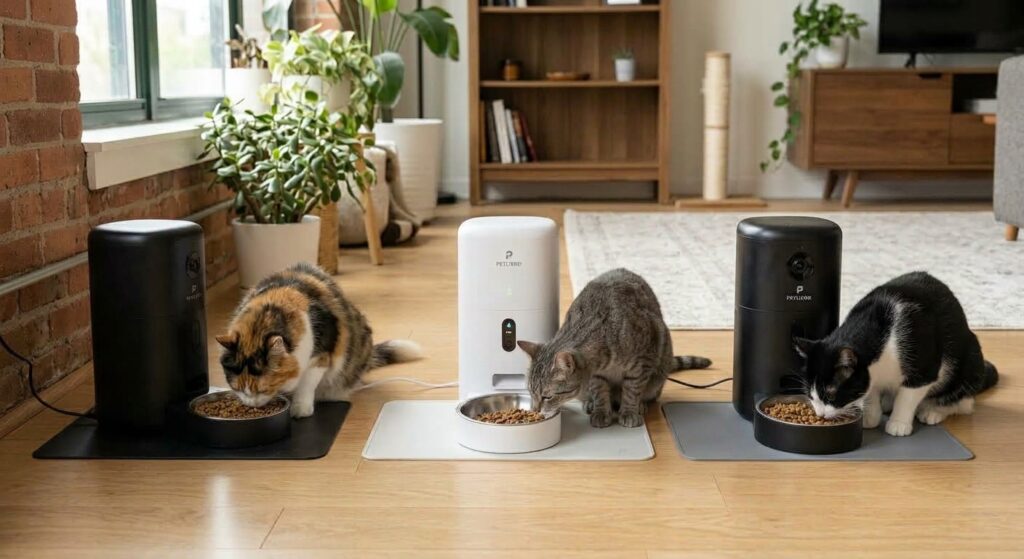
The mechanics are simple. Each cat’s tag or microchip is registered to a feeder. When a registered cat approaches, the reader recognizes them and the lid opens; when any other cat approaches, the lid stays closed. In a multi-cat household, that turns one shared problem into separate, individual feeding stations, each one reserved for the right cat.
Your household needs one if any of these are true:
- One cat is on a prescription or therapeutic diet that the others shouldn’t eat, or that they’d happily eat instead of their own food.
- One cat is on a weight-loss plan while the others aren’t.
- One cat eats faster or bullies others away from food, so portions don’t end up where you intended.
- You need to know exactly what one specific cat is eating, not just what disappeared from the bowl.
If your cats eat peacefully and all share the same diet, a simpler feeder may be all you need. But if you’ve ever caught one cat finishing another’s dinner, access control is the feature that solves it.
What should you look for in an automatic cat feeder for multiple cats?
Beyond the type of feeder, a few specifications decide whether a model fits your household.
Dispensing vs. a protected bowl. Some access-control feeders dispense scheduled meals automatically; others simply guard a bowl that you fill yourself. Both protect food, but only a dispensing feeder handles portioning and timing while you’re out.
Wet food or dry food. Most automatic feeders that dispense from a hopper are dry food only. If any of your cats eat wet food, you’ll need a feeder built around a bowl rather than a hopper.
How the feeder identifies each cat. Collar tags work well for cats who tolerate a collar. For cats who don’t, a feeder that reads implanted microchips removes that problem.
How many cats one feeder can serve. Some access-control feeders link to only one tag, meaning one feeder per cat. That sounds like a drawback until you remember the one-bowl-per-cat guidance above.
Power backup. Look for battery backup so scheduled meals continue during a power outage. Check what still works on batteries, since some feeders keep feeding but disable Wi-Fi.
App features and subscriptions. A feeder with a camera may charge a subscription for recorded video history. Confirm what’s free before you buy.
Comparison table
The biggest difference between these feeders isn’t capacity or app features. It’s whether they can stop one cat from eating another cat’s food. Here’s how our three picks and one alternative compare on the specs that matter most in a multi-cat home.
| Best Automatic Cat Feeders for Multi-Cat Homes | PETLIBRO One RFID | SureFeed Microchip Pet Feeder Connect | Petivity Smart Feeder | PETLIBRO Granary Dual Bowl |
|---|---|---|---|---|
| Price (as of Sept. 2026) | ~$130–$150 | $228.00 | $149.99 | $149.99 |
| Feeder type | Access control + scheduled dispensing | Access-controlled bowl (no dispensing) | Recognition and monitoring | Dual-bowl |
| Stops food theft? | Yes, for its tagged cat | Yes, for registered cats | No | No |
| Identifies cats by | PETLIBRO RFID collar tag | Implanted microchip or RFID collar tag | Camera facial recognition | Doesn’t identify cats |
| Cats per feeder | 1 | 1 | Tracks up to 5 | 2 bowls, shared hopper |
| Food type | Dry only | Wet and dry | Dry only | Dry only |
| Power | Plug-in, D-battery backup | 4 C batteries (Hub plugs in) | Plug-in, battery backup | Plug-in, D-battery backup |
| Best for | Most multi-cat homes | Wet food, prescription diets | Per-cat monitoring | Two cats who don’t steal |
Best automatic cat feeders for multi-cat homes (2026)
Here are the three feeders that earned a spot in this guide, each one matched to a different multi-cat need.
PETLIBRO One RFID — best automatic cat feeder for multiple cats overall
The PETLIBRO One RFID is the only feeder in this guide that does both jobs a multi-cat home usually needs: it dispenses scheduled meals automatically, and it keeps other cats out. An RFID reader checks for its paired collar tag before the lid unlocks and food is served, so the cat it’s assigned to gets their meal and nobody else does.
The important detail is that one feeder syncs with a single tag. In a multi-cat household, that means one feeder per cat. That’s the right setup anyway, since it gives each cat their own feeding station, and it’s how PETLIBRO intends the feeder to be used in homes with more than one cat. Each feeder schedules up to 10 meals or snacks a day through the PETLIBRO app, holds about 13 cups of dry food, and supports both 2.4 GHz and 5 GHz Wi-Fi. It runs on a power cord with three D batteries as backup (not included); on batteries alone, meals still dispense on schedule but Wi-Fi is disabled.
Two limitations to know before buying: it’s dry food only, and its reader works only with PETLIBRO’s own collar tag, not your cat’s implanted microchip. If one of your cats refuses to wear a collar, the SureFeed below is the better fit for that cat.
PETLIBRO One RFID $149.99
SureFeed Microchip Pet Feeder Connect — best for wet food and prescription diets
The SureFeed Microchip Pet Feeder Connect is the pick for any cat whose food truly needs protecting. It reads either your cat’s implanted microchip or an RFID collar tag, and its sealed bowl opens only for a registered cat. It works with both wet and dry food, which makes it the only feeder in this guide suited to a wet-food diet. Sure Petcare positions it specifically for overweight cats, cats with medical conditions that require close monitoring of feeding, and multi-pet homes where one pet steals another’s food.
The trade-off is that the Connect doesn’t dispense meals. You fill its 400 ml bowl yourself, guided by built-in scales and LED lights that signal when you’ve reached the right portion. The app then tracks how much and how often each cat eats, which is useful information to bring to your veterinarian. App features require Sure Petcare’s Hub, which connects to your home router and is sold separately or as a bundle. The feeder itself runs on four C batteries, rated for about six months.
If you don’t need the app or intake tracking, Sure Petcare also makes a standard, non-connected SureFeed Microchip Pet Feeder with the same access control.
SureFeed Microchip Pet Feeder Connect $228.00
Petivity Smart Feeder — best for monitoring multiple cats
Purina’s Petivity Smart Feeder launched in September 2026, and it takes a different approach from the two feeders above. Instead of collars or microchips, it uses a built-in camera and AI facial recognition to identify up to five cats, tracking each cat’s portion consumption, eating frequency, and feeding patterns over time. The Petivity app also handles remote feeding, custom schedules, live video check-ins, and low-kibble alerts, and Purina states that no subscription is required for any of it. If you already use Petivity’s Smart Litter Box Monitor, the two pair so you can view eating and litter box data side by side.
What it doesn’t do is stop a cat from eating another cat’s food. Petivity’s materials describe identification and tracking, not access control, so this isn’t the right feeder for a prescription diet or a persistent food thief. It’s the right feeder for households where the goal is knowing who’s eating what, so you can spot a change in one cat’s appetite early.
It’s dry food only, with a stainless-steel bowl and a dishwasher-safe food container, kibble carousel, and bowl. Because it’s brand new, it doesn’t yet have the long track record of the other picks here, and we’ll update this section as owner experience builds.
Petivity Smart Feeder $149.99
Also considered
PETLIBRO Granary Smart Camera Feeder Dual Bowl. A well-built feeder with a 1080p camera, night vision, two-way audio, and local microSD recording, so video history doesn’t depend on a subscription. It’s a reasonable choice for two cats who eat politely and share the same food. It’s a dual-bowl feeder in the truest sense, though: one hopper dispenses a single scheduled meal that’s divided between two open bowls, with no way to schedule the bowls separately and nothing to stop one cat from eating both portions.
PETLIBRO Granary Dual Bowl $149.99
PETKIT YumShare Dual-hopper with Camera. We looked at this one because of its name, but it isn’t a two-cat feeder. Its two hoppers let you store and blend two different foods, and they dispense into a single shared bowl. It may suit one cat who needs a food blend, but it isn’t a fit for a multi-cat household.
How do you introduce an access-control feeder to your cats?
Introduce it gradually, starting with the feeder working as an ordinary open bowl, then adding the moving lid in small steps. A cat that’s startled by the lid on day one may avoid the feeder entirely.
Start with an open bowl. Register each cat’s tag or microchip, place the feeder where that cat already eats, and use its open or training mode for several meals with their usual food inside. Don’t reduce their food to make them use it.
Introduce the lid slowly. Once your cat eats from it comfortably, use a delayed or slow-closing lid setting if the feeder offers one, then shorten the delay over several days. Move more slowly with timid, senior, or newly adopted cats.
Watch the first week or two closely. Supervise several meals, confirm each cat is eating their normal amount, and watch for another cat crowding in while the lid is open. Access control stops most food theft, but a feeder can’t solve bullying on its own.
Placement matters as much as the technology. FelineVMA feeding guidance from the AAFP recommends separate feeding stations with distance and visual separation between cats. Put each feeder somewhere a cat can eat without passing close to another cat, keep feeders away from litter boxes, and avoid hallways or corners where a timid cat can be blocked in.
If a cat stops approaching the feeder, eats noticeably less, or loses weight, go back to the open-bowl stage and talk to your veterinarian. For a cat on a prescription diet, never change the diet or amount to speed up training.
FAQ
Here are answers to the questions multi-cat owners ask most often when choosing an automatic cat feeder.
Which automatic cat feeder is the most accurate for portion control?
For exact portions, the SureFeed Microchip Pet Feeder Connect has the most precise approach: Sure Petcare says its built-in scale guides you to within 1 g as you fill the bowl. Hopper feeders like the PETLIBRO One RFID and Petivity dispense preset portions instead, so accuracy can vary with kibble size and shape. No independent testing compares these feeders head to head, so if precise portions matter for your cat’s health, weigh the food occasionally and check your cat’s weight with your veterinarian.
Can two cats share one automatic cat feeder?
They can, but a shared feeder can’t make sure each cat gets their own portion. A dual-bowl feeder works for two cats who eat politely and share the same diet. If one cat eats faster, bullies, or needs different food, give each cat their own access-control feeder instead.
Can an automatic feeder keep one cat out of another cat’s prescription food?
Yes, if it’s an access-control feeder. The SureFeed Microchip Pet Feeder Connect and PETLIBRO One RFID both keep their bowls closed to unregistered cats. Recognition feeders like the Petivity and dual-bowl feeders like the PETLIBRO Granary don’t. Supervise several meals before relying on any feeder for a prescription diet.
What’s the difference between an RFID feeder and a microchip feeder?
An RFID feeder reads a tag worn on the cat’s collar; a microchip feeder reads the chip already implanted under your cat’s skin. SureFeed feeders read both. The PETLIBRO One RFID reads only its own collar tag, so it won’t recognize an implanted microchip.
Can automatic cat feeders handle both wet and dry food for multiple cats?
Most can’t. Feeders that dispense from a hopper, including the PETLIBRO One RFID, Petivity, and PETLIBRO Granary, are dry food only. Of the feeders in this guide, only the SureFeed Microchip Pet Feeder Connect handles both wet and dry food, because it’s built around a protected bowl rather than a hopper. The trade-off is that you fill the bowl yourself rather than having meals dispensed automatically. In a household where one cat eats wet food and the others eat dry, a SureFeed for the wet-food cat and a dispensing feeder for the others can work well together.
Does the Petivity Smart Feeder stop cats from stealing food?
No. Petivity describes the feeder as identifying up to five cats and tracking what each one eats, but nothing in Purina’s materials says it blocks other cats from the bowl. It tells you which cat ate, not which cat is allowed to.
Do smart cat feeders require a subscription?
It depends on the feeder. Petivity states that no subscription is required for its features, and the PETLIBRO Granary can record video locally to a microSD card. Some other camera feeders charge for recorded video history, so check before you buy.
How long can you leave multiple cats alone with an automatic feeder?
There’s no safe number of days that a feeder alone can guarantee. A feeder can cover scheduled meals, but it can’t refill water, clean litter boxes, or notice if something goes wrong, including a jammed feeder, a power outage, or a cat who stops eating. In a multi-cat home, there’s also no way to know whether a quieter cat is being crowded out of meals while you’re away. Whether you’re gone for a long workday or two days, arrange for someone to check in on your cats rather than relying on a feeder alone.
Are automatic cat feeders worth it for multi-cat homes?
Yes, as long as you choose the type that matches your household. A dual-bowl feeder is worth it for convenience when your cats eat peacefully and share one diet. For a multi-cat household with any feeding conflict, a different diet, or a cat on a weight plan, an access-control feeder is the one worth paying for. It costs more than a standard automatic cat feeder, and one per cat adds up. But the alternative is a feeding plan you can’t actually enforce: prescription food eaten by the wrong cat, a weight-loss plan undone at the shared bowl, or a quiet cat who’s eating less and nobody notices. A feeder that knows which cat is eating turns all of that from guesswork into something you can manage.
If your cats eat peacefully and share one diet, you don’t need to spend at this level. But if you’ve ever stood in the kitchen wondering who ate whose dinner, the PETLIBRO One RFID, one per cat, is the most complete answer, with the SureFeed Connect for wet food or a prescription diet.
Go here for the Best Natural and Holistic Cat Food.