
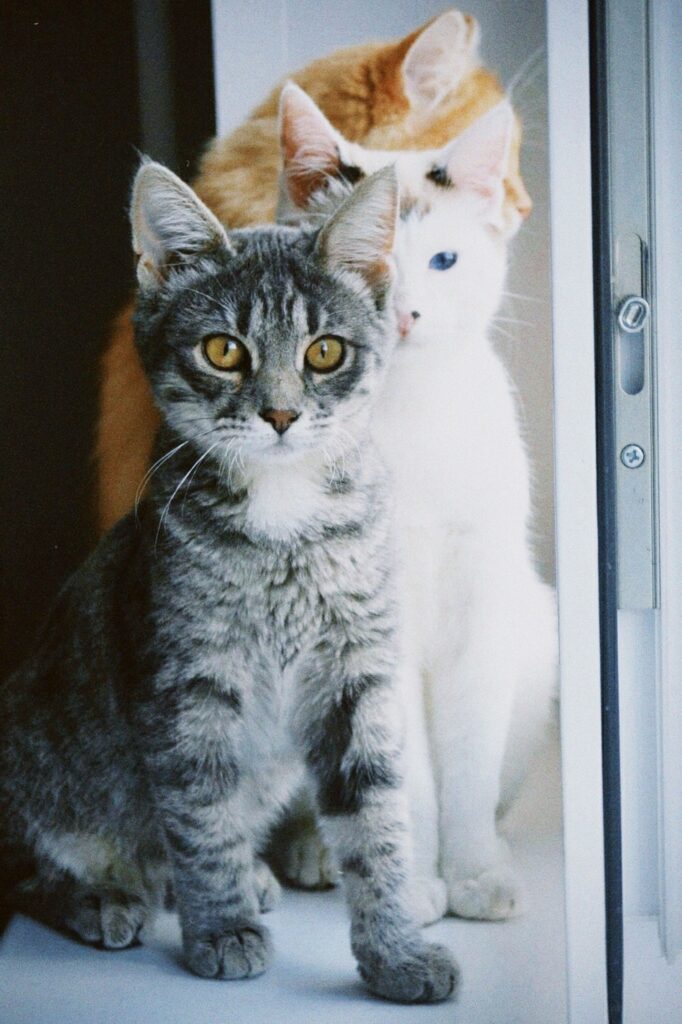
Ask “how many breeds of cats are there?” and you’ll get a different number depending on who’s answering. The Cat Fanciers’ Association (CFA) registers 45 pedigreed breeds. The International Cat Association (TICA) recognizes 73. The Fédération Internationale Féline (FIFe) lists 48 fully recognized breeds, plus two more working their way through preliminary status. None of these numbers is wrong, they’re just answering slightly different questions, because “officially recognized” always means recognized by a particular registry, under that registry’s own rules, at a particular point in time.
This guide to cat breeds breaks down what those numbers actually mean, how a breed gets defined in the first place (it’s not what most people assume), where the whole system came from, and which breeds are the biggest, the rarest, and — despite what a lot of pet sites will tell you — not actually hypoallergenic.
How many cat breeds are recognized by major registries?
| Registry | Recognized breed count | What’s included |
|---|---|---|
| CFA (Cat Fanciers’ Association) | 45 pedigreed breeds | Plus a separate Companion Cat World program for non-pedigreed domestic cats |
| TICA (The International Cat Association) | 73 breeds | Includes breeds at full Championship status; TICA also tracks earlier-stage breeds separately (more on that below) |
| FIFe (Fédération Internationale Féline) | 48 fully recognized breeds | Plus 2 preliminary recognized breeds (Bombay and Lykoi) |
So depending on which registry you ask, the honest answer to “how many cat breeds are there” is somewhere between 45 and 73 — and that range exists for real structural reasons, not sloppy counting.
Each registry writes and enforces its own rules. CFA, TICA, and FIFe each maintain their own breed standards, their own pedigree registration requirements, and their own criteria for when a new breed earns recognition. TICA’s process, for example, requires a proposed breed to have a distinct description, a unique name and breed code, an active breeding program, a genetics review, and eventually a formal written standard before it can move through the recognition stages.
Registries don’t always agree on what counts as one breed versus two. FIFe, for instance, lists the American Curl Longhair and American Curl Shorthair as separate entries, and does the same for the Kurilean Bobtail and the Selkirk Rex by coat length. Other registries may handle those same coat-length variations differently within their own breed listings — which alone can shift a total count by several breeds.
Recognition itself comes in stages, not as a single yes/no. FIFe currently treats Bombay and Lykoi as preliminary recognized, one step below full recognition. TICA uses several formal developmental stages — Registration Only, Preliminary New Breed, and Advanced New Breed — before a breed reaches full Championship status. So a breed can exist, be actively bred, and even be shown, without yet counting toward a registry’s headline “recognized breeds” number.
Put simply: there’s no single global master list of cat breeds. There’s a set of registries, each with its own count, its own standards, and its own timeline for bringing new breeds in.
What’s the difference between a cat breed and a color or pattern?
This is where a lot of casual “cat breed” lists — including plenty of search results for terms like “orange cat breeds” or “calico cat breeds” — get it wrong. Color and pattern are not breeds.
A breed is a population of cats recognized by a registry through a written standard, a documented pedigree and registration framework, and an organized breeding program working toward a defined combination of traits — body type, coat, temperament, and appearance.
A coat color is simply the pigment — black, blue, red/cream, white, chocolate, and so on. A coat pattern describes how that color is arranged: tabby, tortoiseshell, bicolor, colorpoint, and calico are all patterns, not breeds.
A calico, tabby, or tortoiseshell cat isn’t a breed just because it has that coat appearance. Those are color-and-pattern descriptions that show up across multiple breeds — and in plenty of non-pedigreed domestic cats, too.
A calico can be a Persian, a Maine Coon, a domestic shorthair, or any number of other breeds (or no breed at all). The calico coat is simply one possible outcome of certain coat genetics, not a lineage of its own. The same logic applies to tabby markings and tortoiseshell coloring. It’s a genuinely useful distinction to keep in mind any time you see a “cat breeds by color” list — you’re looking at a coat-genetics guide, not a breed guide.
One nuance worth knowing: a pattern can be closely associated with a breed, or even required by its standard, without the two being interchangeable. The Turkish Van, for example, is known for one particular coat pattern — but “Van pattern” and “Turkish Van” still aren’t the same term.
How many cat species are there in total?
Breed and species aren’t the same thing, and it’s worth being precise about the difference. All domestic cats — from a Maine Coon to a Siamese to an unregistered mixed-breed house cat — belong to a single species, Felis catus. A breed is a human-developed lineage within that one species, defined by selectively bred, heritable traits like coat, body type, and temperament. It has no standing as a separate species of its own.
The wider cat family, Felidae, is a different scale of question entirely. Under the IUCN Cat Specialist Group’s current taxonomy, Felidae includes 41 recognized living species — the domestic cat among them, alongside wild felids like lions, tigers, jaguars, and the African wildcat. That number reflects the latest expert consensus rather than a fixed fact carved in stone; feline taxonomy has shifted meaningfully as genetic and morphological evidence has been reassessed, and further revision is always possible.
So: one domestic cat species, dozens of breeds within it, and 41 total species across the broader cat family. Three different numbers, three different questions.
How are cat breeds classified?
There’s no single official classification system that every registry uses — but a few useful, widely-recognized lenses can help make sense of the field.
By origin and breeding history:
- Natural or landrace-derived breeds developed from regional domestic cat populations long before formal breed programs existed, and were standardized later. The Persian, Russian Blue, Siamese, and Angora are among the earliest breeds registered under this kind of foundation.
- Selectively developed breeds were deliberately bred by breeders for a defined appearance, coat, or body type, following a planned pedigree and registry standard. The Bombay is a good example: developed starting in 1953 by crossing a Burmese with a black American Shorthair, with the specific goal of producing a domestic cat that looked like a miniature black panther.
- Hybrid-derived breeds have domestic cat ancestry combined with ancestry from another wild feline species earlier in their development. The Bengal and Savannah are the two most recognized examples — the Bengal traces to early domestic cat × Asian leopard cat (Prionailurus bengalensis) crosses, with the modern breed most closely associated with Jean Mill’s breeding program beginning in the early 1980s, developed toward a companionable domestic cat with the look of a small wildcat rather than simply a spotted coat — though cats eligible for ordinary pet ownership and showing today are many generations removed from those wild ancestors under the relevant registry rules.
By coat and hair type:
- Hairless or near-hairless breeds — the Sphynx, Donskoy, and Peterbald are recognized examples. “Hairless” doesn’t always mean completely hair-free; the exact phenotype varies by breed and individual cat.
- Rex or curly-coated breeds — the Cornish Rex, Devon Rex, German Rex, LaPerm, and Selkirk Rex all fall into this category.
- Longhair, semi-longhair, and shorthair — a useful descriptive category, though coat length alone doesn’t define a breed. Some registries even treat the longhair and shorthair versions of the same breed as separate entries for administrative purposes.
By body type: breeds are also commonly described as slender or foreign-type, moderate, cobby (compact and rounded), semi-cobby, or substantial/large-bodied. Exact terminology and where a given breed falls varies by registry, so it’s worth checking the specific breed standard rather than assuming a universal system.

Where did cat breeds and breed standards come from?
Formal cat breed standards trace back to the organized cat-show movement in nineteenth-century Britain. The most-cited starting point is a Crystal Palace cat exhibition held in London on July 13, 1871 — widely regarded as a landmark event, and arguably the first major, nationwide British cat show, in the development of the modern cat fancy.
Harrison Weir, later known as the “father of the cat fancy,” is credited with proposing the event, drawing up its prize schedule, establishing how the classes would be judged, and serving as a judge himself. He wasn’t necessarily its sole organizer, though — contemporary accounts also credit Frederick W. Wilson of the Crystal Palace’s Natural History Department with managing the exhibition’s day-to-day operations. Weir’s later writing, including Our Cats and All About Them, helped shape early ideas about breed “standards of excellence” that influence pedigree cat evaluation to this day.
From there, the major registries followed:
- CFA was founded in 1906 and remains a pedigree registry and cat-show governing body today. The American Shorthair was one of CFA’s first five recognized breeds at that founding — CFA says it’s believed to trace its ancestry to cats brought from England by early settlers, developed over generations as a working cat before breeders began standardizing it into a pedigree breed. It was originally shown as “Domestic Shorthairs” before CFA renamed it the American Shorthair in 1966, to emphasize its “All American” identity and distinguish the standardized pedigree breed from other shorthaired cats — including non-pedigreed cats found in streets, neighborhoods, and barnyards.
- FIFe grew out of a 1949 meeting in Paris and formally adopted its statutes and rules at its first General Assembly in Ghent in December 1950.
- TICA was founded in June 1979 and held its first cat show the following month.
Among the longest continuously recognized breeds across these registries are the Persian, Siamese cats, Abyssinian, Manx, Russian Blue, Chartreux, and Turkish/Angora-type cats — though the exact documented history and modern standard differs by registry.
And breed recognition hasn’t stopped. New breeds are occasionally proposed and move through a registry’s formal stages — TICA’s Registration Only, Preliminary New Breed, and Advanced New Breed categories exist specifically to bring emerging breeds into the system over time, sometimes across a period of years.
What are the most popular cat breeds right now?
Based on CFA’s most recently published ranking (2025, reflecting 2024 CFA registrations), the ten most popular pedigreed breeds are:
| Rank | Breed |
|---|---|
| 1 | Maine Coon |
| 2 | Ragdoll |
| 3 | Persian |
| 4 | Exotic |
| 5 | Devon Rex |
| 6 | Abyssinian |
| 7 | British Shorthair |
| 8 | Siberian |
| 9 | Sphynx |
| 10 | Russian Blue |
It’s worth being precise about what this ranking actually measures: it reflects CFA pedigree registrations, not a survey of every pet cat in the United States. A breed can be enormously popular as a family pet without ever being CFA-registered, since the vast majority of pet cats are domestic shorthairs and mixed-breed cats with no pedigree at all.
The Maine Coon’s #1 spot is well-earned — see our Maine Coon Characteristics guide for a full look at what makes the breed so popular, from its size and personality to what prospective owners should know before bringing one home.
What is the rarest cat breed?
There’s no single defensible answer to “the rarest cat breed” across every registry, country, and way of measuring rarity. Registries recognize different sets of breeds, don’t all publish comparable annual numbers, and “rare” can mean low registration counts, few active breeders, a small living population, or limited geographic distribution — none of which are measured the same way from one source to the next.
The most trustworthy statement available comes from CFA itself, which identifies the American Bobtail, American Wirehair, LaPerm, Khao Manee, and Turkish Van as among its rarest breeds — the least frequently registered breeds within the CFA system, reflecting relatively few breeders and relatively few cats bred. That’s a solid, source-backed answer for “rare within CFA specifically.” A confident claim about the single rarest breed in the world isn’t something the data actually supports.
What are the largest cat breeds?
If you’re picturing a genuinely big cat, a handful of breeds consistently earn a spot on “largest breed” lists — though “largest” can mean different things depending on whether you’re talking about weight or overall size and length.
| Breed | Typical adult weight |
|---|---|
| Maine Coon | 13–18 lb (males), 9–13 lb (females) |
| Ragdoll | 15–20 lb (males), 10–15 lb (females); males may exceed 20 lb |
| Siberian | 12–18 lb |
| Norwegian Forest Cat | 12–16 lb (males), 9–12 lb (females), reaching full size around age five |
| Savannah | Tall and long-legged, but often lighter than its size suggests |
The Maine Coon and Ragdoll are the strongest picks for genuinely heavy-bodied cats. Ragdoll males in particular can top 20 pounds. The Savannah deserves a caveat: its tall, lanky build creates the visual impression of a much heavier cat, but most Savannahs actually weigh less than another breed of comparable apparent size. If you’re weighing “largest” by looks rather than the scale, Savannah earns its spot; if you’re weighing it by pounds, Maine Coon and Ragdoll are the more reliable answer.
If you already share your home with one of these bigger breeds — or you’re considering one — a standard-sized cat tree usually won’t cut it. Our guide to the best cat trees for large cats covers what to look for in terms of weight capacity and base stability.
Are any cat breeds truly hypoallergenic?
No. Despite how often certain breeds — Siberian, Balinese, Devon Rex, Cornish Rex, Russian Blue, Bengal, Oriental Shorthair, LaPerm, and Sphynx among them — get marketed or informally reputed as “hypoallergenic,” there’s no scientific evidence that any breed is reliably low-allergen or allergen-free. Every cat studied to date produces Fel d 1, the primary protein responsible for most cat allergies (more than 90% of cat-allergic people react specifically to it), and how much of it any individual cat produces varies enormously — by the cat, not by the breed.
A small pilot study did find lower Fel d 1 levels in cats informally described as “hypoallergenic” compared to other cats, but the study involved only 14 cats total and doesn’t establish a reliable breed-level effect. Separately, researchers have found genetic variation in the two genes responsible for Fel d 1 production in Siberian cats specifically — an interesting research thread, but one that hasn’t yet been shown to translate into a meaningfully lower-allergen cat in practice.
What actually seems to matter more than breed is the individual cat: sex and hormonal status play a role (unneutered males tend to produce more Fel d 1 than females), and individual variation is substantial even within the same breed. If allergies are a concern, spending time with the specific cat you’re considering — and talking to an allergist — will tell you far more than any breed label will.
Do cat breeds influence personality or health?
To a degree, yes — but breed is a clue, not a guarantee, on either front. Research using validated feline behavior questionnaires has found real, statistically significant differences between breed groups in traits like activity level, sociability toward people, and vocal or behavioral style. That supports breed as a genuine, if general, predictor of tendencies — not just marketing language or internet folklore.
The same is true on the health side. Some pedigreed breeds do carry documented, breed-associated risks for certain inherited conditions, a pattern well recognized by veterinary and feline welfare organizations that support genetic screening and health-conscious breeding practices. But that doesn’t mean every purebred cat is less healthy than every mixed-breed cat — recent large-scale research has actually found that purebred and mixed-breed cats differ across disease categories in both directions, not in one uniform “purebred is riskier” pattern.
Neither association predicts a single cat’s outcome. A breed’s typical temperament and health tendencies describe a population average, shaped further by an individual cat’s genetics, early experience, and environment. If you’re considering a specific breed, the right move is to ask the breeder about relevant health screening and family history, and talk to your veterinarian about anything breed-specific — which is exactly the kind of detail our Cat Health articles dig into.
Do purebred cats live longer than mixed-breed cats?
On average, yes, though the difference is modest rather than dramatic. Large veterinary datasets from the UK have found crossbred cats living roughly 1.5 years longer than purebred cats — one primary-care study found a median longevity of 14.0 years for crossbred cats versus 12.5 years for purebred cats, and a separate life-table study estimated life expectancy at birth of about 11.9 years for crossbred cats versus 10.4 years for purebred cats.
Body size tells a murkier story. Some larger breeds — including Bengal, Ragdoll, Maine Coon, and British Shorthair — have shown somewhat reduced longevity compared to crossbred cats in UK study data, but the overall relationship between body size and lifespan in cats isn’t nearly as clean or predictable as the well-known size-lifespan pattern in dogs. These are population-level patterns, useful for understanding averages across large groups of cats — not a prediction for any individual cat’s lifespan.
Are new cat breeds still being created?
Yes. Breed recognition is an ongoing, active process, not something that stopped decades ago. Registries like TICA maintain formal pathways — Registration Only, Preliminary New Breed, and Advanced New Breed — specifically to bring newly developed or newly documented breeds into the system, sometimes over a period of several years, before they reach full Championship recognition. FIFe currently has two breeds, Bombay and Lykoi, sitting at preliminary recognized status for exactly this reason. New breeds typically emerge either through the discovery and standardization of a distinct natural population, or through a deliberate, documented breeding program working toward a specific set of traits.
Frequently Asked Questions
How many breeds of cats are there? It depends on the registry: CFA recognizes 45 pedigreed breeds, TICA recognizes 73, and FIFe fully recognizes 48 (with two more at preliminary status). There’s no single global authority that sets one universal number.
Is a calico a cat breed? No. Calico describes a coat pattern — a mix of black or dark patches with red or cream patches, usually with white — that can occur across many different breeds, as well as in cats with no pedigree at all.
What’s the oldest recognized cat breed? Several breeds share strong claims to “oldest,” depending on the registry: the Persian, Siamese, Abyssinian, Manx, Russian Blue, Chartreux, and Turkish/Angora-type cats are all among the longest continuously recognized breeds in major registry traditions.
Is any cat breed actually hypoallergenic? No breed has been scientifically proven to be hypoallergenic. All cats produce the Fel d 1 allergen to some degree, and how much varies by the individual cat rather than by breed.
How does the number of cat breeds compare to dog breeds? Dog breed counts are typically cited in the hundreds, well above any cat registry’s total. This is a reflection of how much longer and more deliberately dogs have been bred for distinct working roles and physical types.
Choosing a breed that actually fits your life
The honest takeaway from all of this is that “how many cat breeds are there” doesn’t have one tidy answer — and it doesn’t need to. What matters more than the exact count is understanding what a breed actually represents: a documented lineage and standard, not just a color, a size, or a look you like. Whether you’re drawn to a Maine Coon’s size and easygoing nature, a Siamese’s vocal, people-oriented personality, or a specific coat type, the right breed for a feline friend for your home comes down to temperament, energy level, and grooming needs fitting your actual day-to-day life — not just how a cat looks in a photo.