
Affiliate Disclosure
Cat & Whisker participates in the Amazon Associates Program. We may earn a commission on qualifying purchases — at no extra cost to you. We only recommend products we’d genuinely put in front of our own cats. Read our full disclosure policy.
The best cat trees for apartments and small spaces are not necessarily the smallest ones you can find, but rather the ones that trade floor space for vertical space. Cats do not experience a small apartment the way you do. A tall, narrow cat tower with a stable base gives a cat more usable territory to climb, perch, and lounge on than a wide, low one, while taking up a fraction of the room. That is the whole logic behind every pick in this guide.
Whether this is your first cat tree or a replacement for one that is starting to fall apart, three things decide whether it earns its footprint: a compact base, genuine stability, and construction that holds up to years of a cat who loves to climb. This guide covers three cat trees built around that trade-off, plus where to put a cat tree in your apartment so your cat actually uses it.
How can I keep my cat happy in a small apartment?
A cat in a small apartment stays happy when its territory grows upward, not outward. The essentials are vertical space to climb and survey from, a window to watch, a scratching outlet that isn’t your furniture, somewhere enclosed to retreat to, and a few minutes of interactive play each day to burn off hunting energy. Square footage matters far less to a cat than whether the space it has is interesting and its own.
A good cat tree covers three of those five in a single footprint, which is why it is usually the first piece of cat furniture worth investing in for an apartment.
What are the benefits of a cat tree in a small apartment?
A cat tree gives an apartment cat three things a couch and a windowsill can’t: real vertical space, a scratching outlet, and a place to retreat to.
Vertical space without giving up floor space. A cat tree that climbs upward rather than sprawling outward turns unused air into usable territory. Your cat will have multiple perches and platforms in the footprint of a single side table. The American Animal Hospital Association notes that safe vertical space is essential indoor enrichment, letting cats climb, rest, and survey their surroundings from above; and that without an appealing designated option, some cats will use household furniture or drapes instead. For indoor cats especially, that vertical space matters: without it, climbing instincts get redirected onto bookshelves, counters, and curtains.
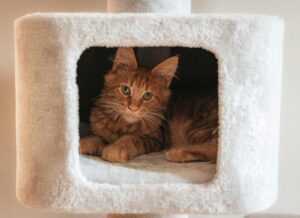
A cat cave for downtime. Enclosed condos and covered perches work as a genuine hideaway, a cat cave your cat can crawl into when the apartment gets loud or busy, which matters more in a studio where there’s nowhere else to get away from foot traffic.
A scratching post that isn’t your furniture. Scratching is a normal feline behavior used for claw conditioning, stretching, and scent marking. It is not a habit to train out, but rather one to redirect. Sisal-wrapped posts give a cat somewhere to scratch that is not your couch, your carpet, or — for renters — your walls and door frames, which is one of the more expensive things a cat can do to a security deposit.
What should I look for in a cat tree for a small apartment?
Look for a compact, corner-friendly base with good height, and avoid a shrunken version of a tall cat tower built for a house.
How tall should a cat tree be for an apartment?
It depends on the cat more than the apartment. For a studio, a kitten, or a small cat, 28–30 inches on a 16″×16″ base is enough to give real multi-level climbing without dominating a corner. A full-grown adult cat that loves to climb will use a taller tree, in the 50–60 inch range, like the 53-inch B5301. Pair that height with a wider base for stability. If you want floor-to-ceiling height without a wide footprint, a ceiling-brace tower is the better route (more on that below).
Base stability matters more, not less, in a tall design. A narrow, vertical cat tower concentrates more force at the base when a cat jumps down from the top perch than a short, wide one does. Check the actual base dimensions, not just the overall footprint, before assuming a tall tree will be stable in a small space.
Construction: pressed wood is standard, real wood is the upgrade. Most cat trees and cat condos in this category use pressed wood (engineered particleboard) under a fleece or fur covering. That is a normal, durable build, and there is nothing wrong with it. A smaller number use real wood, like Scots pine, which costs more but reads and wears differently over years of scratching, climbing, and lounging. Neither is “solid wood” in the single-milled-plank sense. Even premium models are typically layered natural wood, not a solid slab. So treat “real wood” and “solid wood” as different claims when you are comparing listings.
Renter-friendly by default, not by design compromise. All three cat trees below are freestanding. No wall anchors, no drilling, no landlord conversation required to install one.
Comparison Table
| Best Cat Trees for Apartments and Small Spaces | Armarkat S2906 | Armarkat X2905 | Armarkat B5301 |
|---|---|---|---|
| Price | $66.99 | $37.99 | $117.62 |
| Size | 16″×16″×29″ | 16″×16″×30″ | 24″×22″×53″ |
| Max weight | 30 lb | 15 lb | 40 lb |
| Construction | Real wood (Scots pine) | Pressed wood | E1-certified pressed wood |
| Best for | Design-conscious apartments | Kittens & small cats, studios | Adult cats, more climbing height |
| Amazon rating | 4.6 (7 ratings) | 4.2 (10 ratings) | 4.6 (6,446 ratings) |
What are the best cat trees for apartments and small spaces?
These are the three cat trees that earned the top spots in this guide, and exactly who each one is built for.
Armarkat S2906 — best for design-conscious apartments
The Armarkat S2906 stands out because it’s built from real wood, not a relabeled version of a standard carpet-covered tower. Its frame is plied Scots pine with visible wood grain and a polished finish, on a 16″×16″ base standing 29 inches tall — compact enough for a studio corner, with a doubled base for extra stability given the narrow footprint. Sisal-wrapped posts still handle the scratching duty, but the exposed-wood look means it reads as a genuine piece of furniture rather than traditional pet-store carpet-and-fluff construction. Rated for cats up to 30 lb, it suits one cat comfortably rather than a home with multiple cats. If you want a cat tree that doesn’t visually compete with the rest of your apartment, this is the one to start with.
Armarkat X2905 — best for studios and kittens
Same 16″×16″ footprint as the S2906, standing 30 inches tall, but built for a different cat entirely. The Armarkat X2905 is a compact starter tree sized for kittens and small adult cats, with a 15 lb weight rating. Construction is standard pressed wood with sisal-wrapped posts — solid and reliable, just not the premium tier. The tradeoff for the lower weight capacity is the smallest footprint of the three, which makes it the right choice for a really tight space or a young cat that hasn’t grown into a taller cat tower yet. It’s not the pick for a full-grown large cat or a household with two cats sharing one tree.
Armarkat B5301 — best for adult cats who want more height
At 24″×22″×53″, the Armarkat B5301 is the tallest and most capable of the three — a 5-level modern cat tree with a ramp, perch, condo, and hanging toy, rated for up to 40 lb. Construction is E1-certified 15mm pressed wood, reinforced with 3.5″ sisal-wrapped posts, under a fully glued 650g/m² faux fleece covering that holds up better over time than lighter, stapled fabric. It’s also the most proven of the three by a wide margin: 4.6 stars across 6,446 Amazon ratings is a genuine track record, not a spec-sheet claim. The one caveat from customer feedback is that larger cats in the 18 lb-plus range may find the top perches a little snug — this one’s built for one to two average adult cats, not a full-grown Maine Coon.


How do I choose the right cat tree for my space and cat?
Match the cat tree to your cat’s size first, your square footage second.
Kittens or small cats: the X2905‘s smaller footprint and lower weight rating fit best — no reason to pay for height a kitten will not use for another year.
Adult cats who love to climb: the B5301‘s extra height and 40 lb capacity give a full-grown cat real climbing range without a bigger base underneath it.
Design-first apartments: the S2906, if you would rather the piece read as furniture than pet equipment, and you have one cat under 30 lb.
Homes with multiple cats: prioritize weight capacity and perch count over footprint. Of these three, the B5301 handles two cats sharing space better than the other two.
Where should I place a cat tree in a small apartment?
Placement will determine whether a cat actually climbs up and uses the tree.
Near a window is the single best spot for any cat tower. It turns the perch into a lookout post, which is the biggest single driver of daily use for indoor cats.
In a corner adds real stability (the walls give a narrow base extra support against tipping) and reclaims space that would otherwise be empty.
Away from foot traffic. A cat tree in a hallway or doorway gets ignored even if it is a great cat tree. Cats want to observe human traffic, not sit in the middle of it.
What are good alternatives to traditional cat trees for small spaces?
If a freestanding tree won’t fit, there are three alternatives that deliver vertical space differently.
Window perches mount to a sill or attach to glass, and they give a cat a lookout post with almost no footprint. They’re a good supplement to a tree, though not a replacement for climbing.
Wall-mounted shelves and steps use zero floor space and can be arranged into a climbing route around a room. The trade-off for renters is that they need to be anchored into wall studs, which means drilling and usually a conversation with your landlord.
Ceiling-brace cat trees use tension between floor and ceiling instead of a wide base. That gives them serious height and weight capacity in a narrow footprint, without drilling. Check the listing’s ceiling-height range before buying. For a detailed pick, see our guide to the best cat trees for large cats.
FAQ
Do cat trees actually work in small apartments?
Yes. The compact, vertical designs above are built specifically to maximize climbing space over floor space, which is exactly what makes them work in studios and one-bedrooms where a large, wide cat tower simply wouldn’t fit.
What size cat tree is right for a studio apartment?
A 16″×16″ base with 28–30 inches of height, like the S2906 or X2905, fits comfortably into a studio corner without taking up too much floor space or dominating the room.
Will a cat tree damage my rental walls or floors?
Freestanding cat trees like all three above need no wall anchors or drilling to install. A washable mat underneath protects flooring from shedding fur and litter tracked in from paws.
How do I get my cat to actually use a new cat tree?
Place it near a window rather than against an interior wall, and give your cat time to investigate on their own schedule. Cats vary in how quickly they explore something new, so encouraging first use with toys, catnip, treats, or positive reinforcement is a normal and recommended part of introducing a new cat tree, and does not indicate that you have chosen wrong.
Can one cat tree work for two cats in a small space?
Yes, if it has enough perches and a high enough weight rating. The B5301‘s 5 levels and 40 lb capacity handle two cats sharing one tree noticeably better than a single-perch design will.
What is the most stable cat tree for a small apartment if I have a large cat?
None of the three trees above is built for a cat over about 18 lb. For a Maine Coon or another large breed in a small space, a ceiling-brace design like the Go Pet Club Classic is the most stable option. It’s rated for 80 lb on a 30″×18″ base, because the floor-to-ceiling tension does the stabilizing work a wide base would otherwise need to do. Our [large cat tree guide](internal link) covers it in detail.
Are corner cat trees better for small spaces?
Usually, yes. A tree placed in a corner gets extra support from two walls against tipping, and it uses space that’s otherwise dead. You don’t need a specifically corner-shaped design to get that benefit. Any compact freestanding tree, like the S2906 or X2905, works well tucked into a corner.
Are cat trees worth it for apartment cats?
Yes — arguably more than in a house, because an apartment cat has fewer other places to climb, scratch, and get away. The catch is that a cheap, unstable cat tree in a small apartment tends to become an expensive piece of clutter fast. Wobbly bases discourage climbing, thin fabric wears through within months, and a cat that will not use the tree will go right back to scratching your furniture instead. In a space where every piece of furniture has to earn its footprint, a high-quality tree your cat actually climbs — built from materials that hold up, on a base that doesn’t wobble — pays back the price difference within the first year just by doing its job and keeping your cat happy.
Best Cat Wall Shelves for Cats (2026 Guide)