
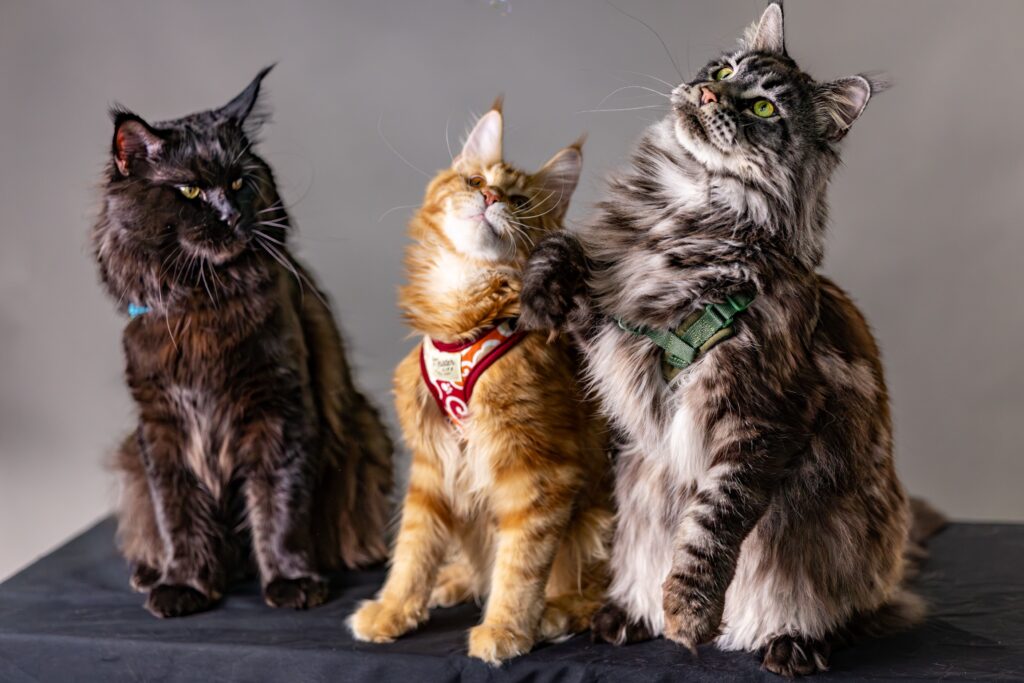
Maine Coons don’t act like most people expect a cat to act. They follow you room to room. Some fetch. Many “talk” in chirps and trills instead of a straightforward meow. And it takes them years — not months — to grow into the size they’re known for.
If you’re considering a Maine Coon, or you already share your home with one and want to understand them better, this Maine Coon Characteristics guide covers what actually defines the breed: physical characteristics, personality traits, energy levels, and the health considerations worth knowing about, all grounded in breed-authority and veterinary sourcing rather than internet folklore.
What Is a Maine Coon?
The Maine Coon is one of the oldest natural cat breeds in North America, and fittingly the official state cat of Maine. The most credible account of their origin, according to both the Cat Fanciers’ Association (CFA) and The International Cat Association (TICA), traces them back to domestic shorthaired cats mating with imported longhaired cats, possibly Angora-type cats brought over by New England sailors. Some breed historians also point to a “Viking longhair” hypothesis. Either way, the breed almost certainly descended from working ship cats brought to America to control rodents, a practical origin for what has become one of the most recognizable breeds in the country.
Two stories you’ll see repeated online are worth setting straight. The idea that Maine Coons descended from domestic cats crossing with raccoons is biologically impossible; cats and raccoons are different genera and can’t hybridize. And both CFA and TICA call it exactly what it is: folklore. The story that Marie Antoinette’s cats made their way to Maine is a charming legend too, but it is not documented history.
What is documented is that a Maine Coon named “Captain Jenks of the Horse Marines” appeared in cat literature as early as 1861, and a brown tabby female named Cosie won Best Cat at the 1895 Madison Square Garden cat show, one of the earliest documented cat shows in the country.
Physical Characteristics and Size
Maine Coons are one of the largest domestic cat breeds. Not, as often claimed, the single largest, since that title depends on the individual cat and how you’re measuring. What’s consistent is the scale: according to TICA, mature males typically weigh 13–18 lb, and mature females typically weigh 9–13 lb. CFA’s official standard doesn’t set a numeric weight target at all — it prioritizes proportion and balance over raw size, which is worth knowing if you’re comparing your cat to an online “average.”
One detail that surprises a lot of owners: Maine Coons are slow to mature. Most cats reach full size well before their first birthday, but Maine Coons typically don’t reach full physical maturity until 3 to 5 years old. That gangly, still-growing look can last for years.
Breed-standard physical features, per CFA, include:
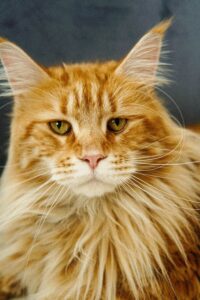
- Ears — large, wide-based, and tapering, with tufting (sometimes called “lynx tips”)
- Paws — large, round, and well-tufted, with the standard five toes in front and four behind
- Ruff — a shaggy frontal ruff is desirable, part of a coat that’s shorter over the shoulders and longer on the stomach and britches
- Tail — long, wide-based, tapering, and covered in long, flowing fur
You may also come across mentions of polydactyl Maine Coons — cats with extra toes. TICA notes the trait was historically common in the breed, possibly because it functioned like natural snowshoes in New England winters, and TICA still recognizes Maine Coon Polydactyls today. CFA’s standard show cats, however, require the standard toe count, so registry treatment of polydactyly differs depending on where a cat is registered or shown.
Coat Colors and Patterns
Maine Coons come in one of the widest color ranges of any recognized breed. CFA-recognized colors and patterns include solid white, black, blue, red, and cream; classic, mackerel, and ticked tabby patterns; silver, smoke, shaded and shell varieties; tortoiseshell and blue-cream; calico; and bi-color or white-marked combinations.
A few colors and patterns are not accepted under CFA’s Maine Coon standard: chocolate, lavender/lilac, and the colorpoint (Himalayan) pattern are considered evidence of hybridization with other breeds and are disqualifying for CFA show cats, though a cat in one of these colors can still make a wonderful pet — it just won’t meet CFA’s Maine Coon show standard.
Personality Traits
This is where the “gentle giant” reputation comes from, and it holds up under scrutiny. CFA describes Maine Coons as sociable, loyal, intelligent, and moderately interactive, as well as affectionate without being needy. TICA’s language is similar: gentle, friendly, clown-like, and people-oriented, but not overly dependent on constant attention.
A few specific traits worth knowing:
They’re not big talkers — but they do “talk.” Maine Coons aren’t typically considered a highly vocal breed, but both CFA and TICA note they communicate through frequent chirps, trills, and purrs, with meowing used more sparingly than in some other breeds.
The “dog-like” reputation is informal, but the behaviors are real. You’ll see Maine Coons described as “dog-like” constantly, and while that’s not an official breed-standard term, TICA does support the behaviors behind it: many Maine Coons follow their people from room to room, some can be taught to fetch or walk on a leash, and they tend to respond well to simple, reward-based training.
They generally do well with kids and other pets. Both CFA and TICA note that Maine Coons typically get along with children, dogs, and other cats, making them a common recommendation for larger, more active households, though, as with any cat, individual temperament, socialization, and proper introductions still matter more than breed alone.
Energy Levels and Activity Needs
Maine Coons land in a comfortable middle ground: playful and engaged, without being the constant-motion energy of some breeds. TICA describes adult Maine Coons as relaxed and easygoing, with kittens being noticeably more active than adults, though many adults stay playful throughout life if their owners keep encouraging it.
One useful detail for how you set up your home: Maine Coons tend to be less vertically oriented than some breeds, often preferring ground-level chase-and-fetch play over climbing to the highest available point. That doesn’t mean skip the cat tree — a large, sturdy tree still gives a big cat room to stretch, scratch, and perch — it just means you don’t need to prioritize height over stability the way you might for a more climb-driven breed. Best Cat Trees for Large Cats
For enrichment, TICA specifically supports interactive toys, fetch, leash walks for cats that take to it, and simple reward-based commands. Beyond that, standard good feline-care practice applies: daily interactive play, scratching outlets sized for a bigger cat, and food puzzles or slow feeders for mental stimulation.
Are Maine Coons a Good Fit for Your Home?
Given their sociable, adaptable temperament, Maine Coons tend to suit a wide range of households — families with children, homes with dogs or other cats, and owners who want a genuinely interactive companion rather than an aloof one. Their size does mean a few practical adjustments are worth planning for: a litter box and cat tree sized for a large cat, not a standard or kitten-sized one, and enough space for them to stretch out fully. Best Self-Cleaning Litter Box Picks for Multi-Cat Homes
Health Considerations for Maine Coons
No breed guide is complete without an honest look at breed-specific health risks. Maine Coons are a large, generally robust breed, but there are three conditions worth knowing about, and none of them should be diagnosed or ruled out based on anything you read online, including this article.
Hypertrophic cardiomyopathy (HCM). Maine Coons are a breed Cornell Feline Health Center and UC Davis both recognize as predisposed to HCM, the most common form of heart disease in cats. Genetic testing can help assess risk in certain lines, but it isn’t a substitute for a cardiac exam — echocardiography, ideally read by a veterinary cardiologist, remains the diagnostic gold standard.
Hip dysplasia. Cornell identifies Maine Coons as a breed with a recognized predisposition to hip dysplasia, related in part to their larger, stockier build. Maintaining a healthy body weight and encouraging regular movement can help support hip health; your vet can assess this through a physical exam and imaging if there’s ever a concern.
Spinal muscular atrophy (SMA). This one is less well-known than HCM but worth understanding: SMA is a rare, inherited neurologic condition documented specifically in Maine Coons. It’s caused by a recessive genetic deletion, and affected kittens typically develop hind-limb weakness, an unsteady gait, and muscle loss starting around 3 to 4 months of age. It’s generally not painful or fatal, and a DNA test (offered through UC Davis’s Veterinary Genetics Laboratory) can identify carriers, which is worth asking a breeder about if you’re getting a kitten.
None of these conditions are guaranteed, and plenty of Maine Coons live long, healthy lives without ever encountering any of them. But they’re worth discussing with your veterinarian and, if you’re buying from a breeder, worth asking about directly.
How Long Do Maine Coons Live?
There’s no single, authoritative Maine Coon-specific lifespan figure from a veterinary source — despite how often a precise range gets repeated online. What’s more accurate is that lifespan depends heavily on genetics, preventive care, body condition, indoor safety, and whether a cat develops a condition like HCM. Cats diagnosed with HCM, per Cornell, can often still live normal or near-normal lifespans with proper management. With good care, it’s common for Maine Coons to live well into their teens.
Maine Coon vs. Other Large Cat Breeds
Maine Coons are often mentioned alongside other large, naturally-occurring breeds like the Norwegian Forest Cat — both share a similar backstory as landrace breeds shaped by cold climates rather than deliberate breeding programs. We’ll cover how Maine Coons stack up against other big breeds in more depth in our upcoming Cat Breeds guide.
Frequently Asked Questions
Are Maine Coons affectionate? Yes. CFA and TICA both describe them as sociable and people-oriented, though — like any cat — how affectionate an individual Maine Coon is depends on personality and socialization, not just breed.
Do Maine Coons make good family pets? Generally, yes. They’re commonly noted for getting along with children and other pets when introductions are handled properly, which is part of why they’re a popular choice for larger, active households.
How big do Maine Coons get? Mature males typically weigh 13–18 lb and mature females typically weigh 9–13 lb, according to TICA. They’re considered one of the largest domestic cat breeds, and they take 3 to 5 years to reach full size.
Are Maine Coons polydactyl? Some are. Extra toes were historically common in the breed, and TICA still recognizes Maine Coon Polydactyls today, though CFA’s standard show cats are required to have the typical toe count.
Are Maine Coons hypoallergenic? No. No recognized allergy authority considers any cat breed, including Maine Coons, hypoallergenic. Cat allergies are triggered mainly by proteins like Fel d 1, found in saliva, skin, and urine — not fur itself — and every cat produces some level of these proteins. A Maine Coon’s long coat can carry and spread allergen-containing dander after grooming, but coat length doesn’t reliably predict how allergenic a given cat is. If you have cat allergies, spend time with the specific cat before bringing one home rather than relying on breed alone.
What health issues should I know about? The three most-discussed breed-specific concerns are hypertrophic cardiomyopathy (HCM), hip dysplasia, and spinal muscular atrophy (SMA). All three are manageable or testable. Talk to your vet, and ask a breeder about DNA testing and cardiac screening if you’re buying a kitten.
How long do Maine Coons live? There’s no single authoritative lifespan figure, but with good care and attention to breed-specific health risks, it’s common for Maine Coons to live well into their teens.